
Hit the bar. Under real aerodynamics.
A 3D, physics-first crossbar-challenge game on Unity 6. The ball flies under genuine drag and Magnus forces rather than along an animated curve, wind is deterministic so it can be learned, and a trajectory preview turns each attempt into a readable adjustment instead of a guess.
In development — not yet released
One shot, simulated properly.
Crossbar challenge is the purest test in football: no keeper, no defenders, no tactics — just whether you can put the ball on a bar from distance. It makes an unusually good mobile game because the skill is legible in one attempt and deep enough to keep chasing. Stanga takes the narrow version of that and spends the entire engineering budget on flight physics and shot feel.
The curve is a consequence, not a choice.
Most mobile sports games select an animation and play it. Here the shot is solved: aim, power, curve and spin become initial conditions, and drag and the Magnus effect determine where the ball actually goes. That is why practising transfers — you are learning a system rather than a set of button presses.
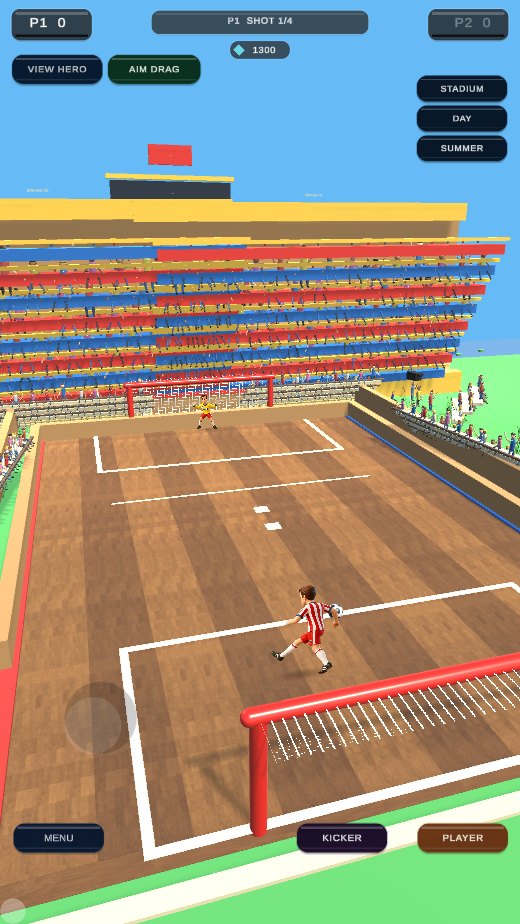
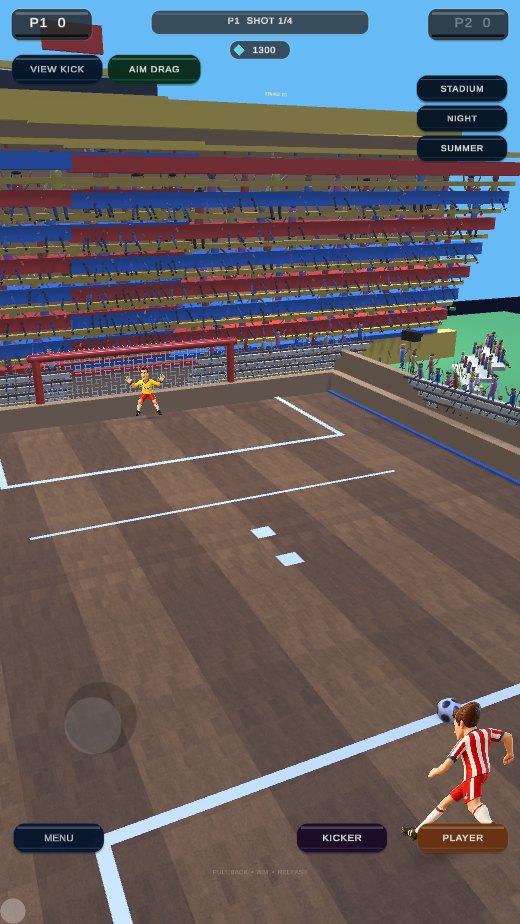
Five things that follow from simulating the ball.
The ball is simulated, not animated
Every shot is solved by real aerodynamics — drag and the Magnus effect — rather than played back along a designed curve. Spin therefore does what spin does: the same strike with different spin genuinely goes somewhere else, and the curve you get is a consequence rather than a selection.
One mechanic, taken seriously
Crossbar challenge is a single, legible skill: hit the bar. That narrowness is the design. It means the entire budget goes into how the ball behaves in flight and how the shot feels to place, instead of into a shallow spread of systems.
Wind is deterministic
Wind affects the flight and it is deterministic, which is what makes it a skill input rather than a random tax. The same conditions produce the same flight, so learning the wind is learning something real.
You can see the shot before you take it
A trajectory preview shows the arc the current aim, power, curve and spin will produce, so the loop is aim, read, adjust — rather than guess, miss, guess again.
Two thumbs, portrait, no tutorial needed
Controls are split across the left and right thumb in portrait orientation. It is a phone game that assumes one hand per thumb and no external controller, and it is legible within a shot or two.
Drag, Magnus, and a wind you can read.
The ball carries real aerodynamic drag and a Magnus force derived from its spin, so a struck ball curves because it is spinning rather than because a curve was selected. Wind is applied deterministically: the same conditions produce the same flight every time, which is what turns wind from an annoyance into a variable worth learning.
Magnus curve
Spin generates lateral force. Side spin bends the flight; top and back spin change the drop.
Aerodynamic drag
Speed bleeds off through the flight, so power and distance are not the same lever.
Deterministic wind
Repeatable, therefore learnable — a skill input rather than a random penalty.
Trajectory preview
See the arc your current aim, power, curve and spin will produce, before committing.
Portrait, two thumbs.
Aim and shot parameters are split between the left and right thumb in portrait orientation, on the Unity Input System, with Cinemachine driving behind, side and broadcast-style camera modes. It is designed for a phone held in two hands and for a player who will not read instructions.
What is built and running.
The development build plays. Practice, Classic Stanga, Survival and a Daily Challenge are in, along with local two-player pass-and-play on one device and a versus-CPU mode. Three environments — stadium, mountain and sea — and five ball colourways provide the current content.
| Area | Built |
|---|---|
| Ball flight | Aerodynamic simulation with drag and the Magnus effect. |
| Shot control | Aim, power, curve and spin, with a trajectory preview. |
| Wind | Deterministic wind affecting flight. |
| Scoring | Goal and scoring zones, rest and out-of-bounds resolution. |
| Modes | Practice, Classic Stanga, Survival, Daily Challenge, local two-player and versus CPU. |
| Local multiplayer | Pass-and-play on one device. |
| Locations | Three environments — stadium, mountain and sea. |
| Ball skins | Five colourways. |
| Camera | Behind, side and TV camera modes. |
| Build pipeline | A code-driven scene builder with a headless iOS build and an automated screenshot loop. |
Honestly: what is missing.
The design specification for this game is long — tournaments, clans, seasons, country battles, spectator mode. Almost none of it is built, and listing it as though it were would be dishonest. Here is the actual gap between the development build and something releasable.
| Area | Still needed |
|---|---|
| Audio | The game is currently silent. Kick, crowd and whistle effects plus music are the single largest gap before any release. |
| Character & animation | A rigged player with the team kit, a run-up and a kick animation. |
| Keeper | Goalkeeper AI with save dives, and net physics. |
| Online multiplayer | One-versus-one netcode, team and clan play, private rooms and matchmaking. |
| Backend | Accounts, cloud save, leaderboards, replay storage, push and analytics — none of which exist yet. |
| Progression | Experience and levels, ranks and tiers, unlocks and seasons. |
| More modes | Trick shot, tournament, weekly championship, clan wars, stadium challenge and story mode. |
| Content | Additional stadiums, character customisation, ball collection and cosmetics. |
| Presentation | Replay system, particle effects and haptics. |
| Release | Android build, paid developer account, store listings, age rating and privacy policy. |
The game is silent today — there is no sound at all — and there is no backend, so nothing persists beyond the device. There is an iOS development build only: no store listing, no Android build, and nothing available to download. No release date is being given because none has been set.
Engine & tooling.
| Engine | Unity 6 with the Universal Render Pipeline |
|---|---|
| Physics | Three-dimensional rigid-body simulation with custom aerodynamic drag and Magnus forces |
| Input | Unity Input System, two-thumb portrait controls |
| Camera | Cinemachine, with behind, side and broadcast-style modes |
| Platform | iOS development build; Android not yet built |
| Tooling | Code-driven scene construction, headless build and automated screenshot capture |
| Status | In development — not released, and not currently available to the public |
Scenes are constructed in code rather than by hand in the editor, which is what makes the headless build and the automated screenshot loop possible — and is why the screenshots on this page can be regenerated from a commit rather than captured manually.