
Enterprise BI, without the enterprise seat licence.
A fast business-intelligence platform built for broad deployment at a fraction of the licensing cost of the incumbents — a 309-type connector framework, a dbt-style modelling layer, user-defined pre-aggregation over a columnar store, interactive dashboards and scorecards, real geospatial mapping, and the lineage, quality tests and per-view access control that make a number defensible.
The cost of a BI licence decides who is allowed to look.
Most organisations do not have a data problem so much as an access problem: the warehouse is fine, and the number of people permitted a seat is not. Insights Studio was built to be deployed widely and used broadly — which means the engineering had to solve the thing that usually breaks when you do that, namely interactive query performance over large tables. Pre-aggregation is therefore a product feature that users control, not a tuning exercise performed by a specialist.
Built wide on purpose.
Cost positioning is qualitative and deliberately so: it refers to the licensing model, not to a measured saving, and no percentage is published.
Five things that follow from deploying BI broadly.
Enterprise BI without the enterprise seat licence
The commercial reality of most BI platforms is that the licence cost scales with the number of people you would like to be able to see a number. This one is built to be deployed and used broadly at a fraction of that cost — which changes who gets to look at the data, not just what it costs to look.
Pre-aggregation is a first-class feature
Interactive dashboards over large tables are a pre-aggregation problem, not a chart problem. A rollup manager lets users define their own pre-aggregations, materialised into a columnar table and cached, so a dashboard stays interactive as the underlying data grows rather than quietly timing out.
Connect to what you actually have
A pluggable connector framework with a catalogue of 309 source types, covering databases, files and remote services — because the data that matters is never all in one warehouse, and a BI tool that requires it to be is a migration project wearing a costume.
Real maps, not map-shaped pictures
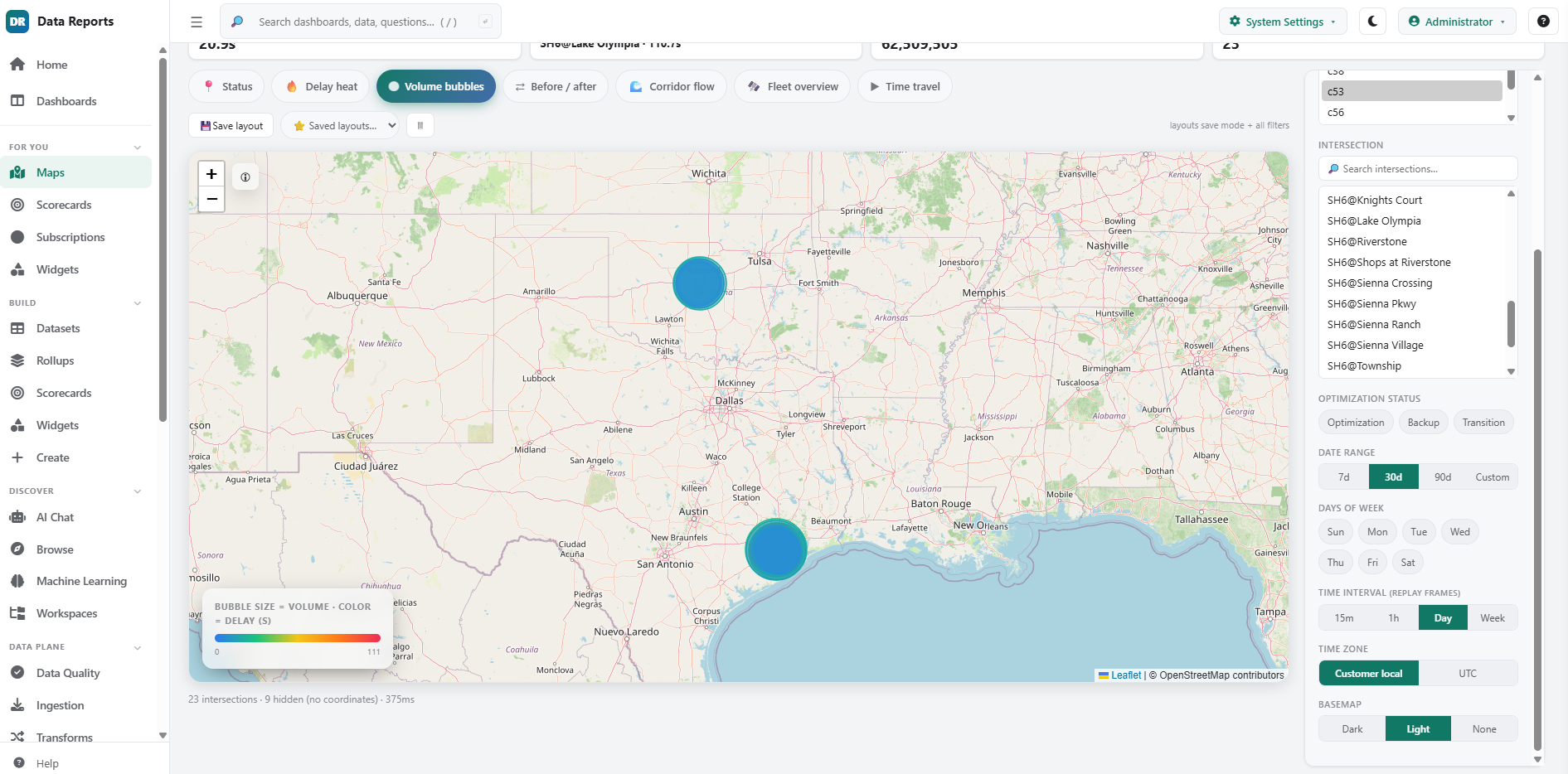
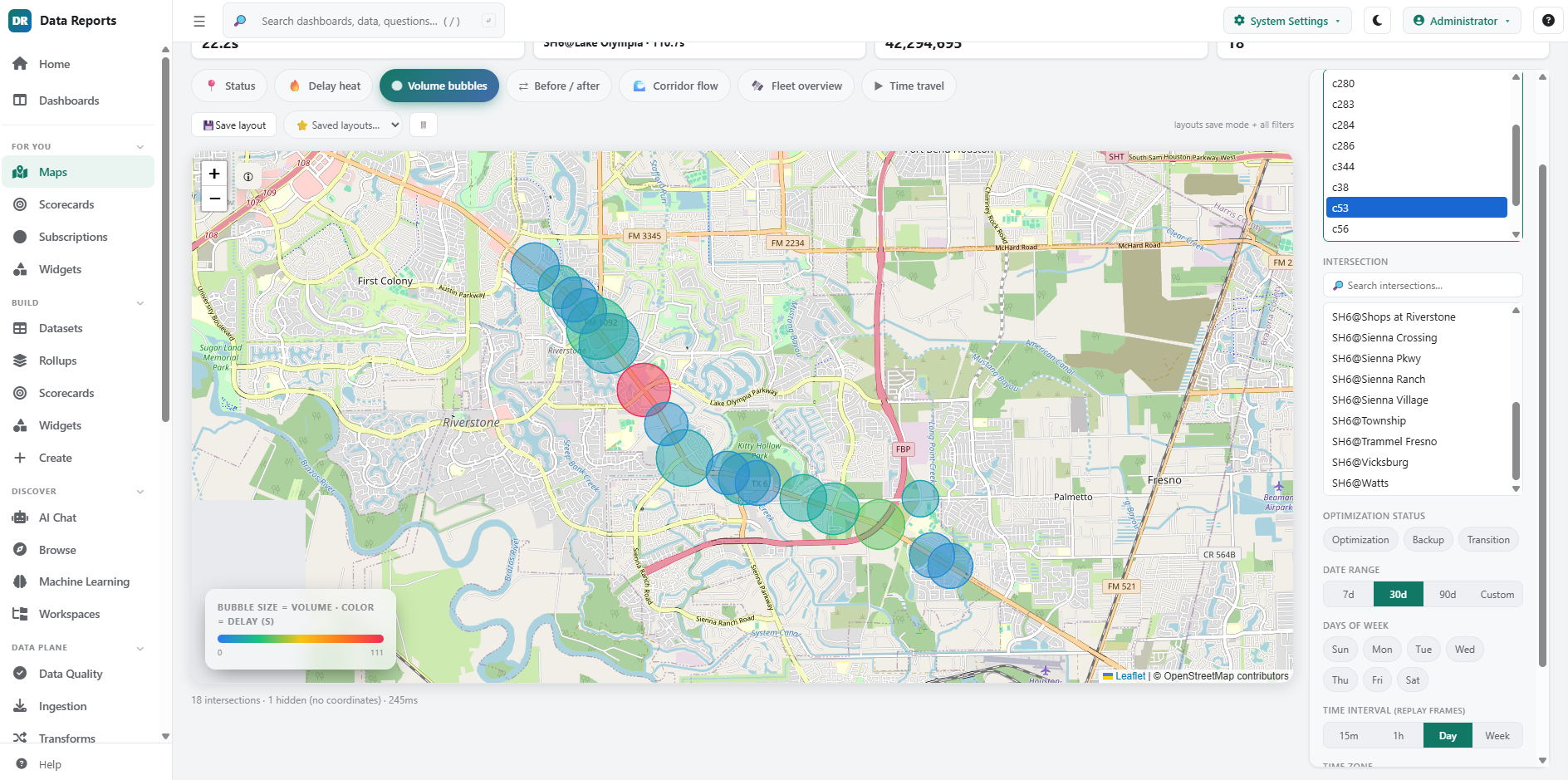
Geospatial output uses real OpenStreetMap tiles with route rendering, alongside a gallery of 309 visuals including the Power-BI-class chart types people expect. Geography is a first-class analytic dimension rather than an afterthought.
You can see where a number came from
Data lineage traces from a connection through to the view, data-quality tests run against the sources, and per-view access control and audit sit over the top. A number nobody can trace is a number nobody will act on.