Imperium — AI Governance & Control
The Enterprise AI Firewall Is Becoming a New Security Layer
Employees send company information to AI tools every day, and because traditional security cannot read those messages, a new kind of checkpoint is emerging.
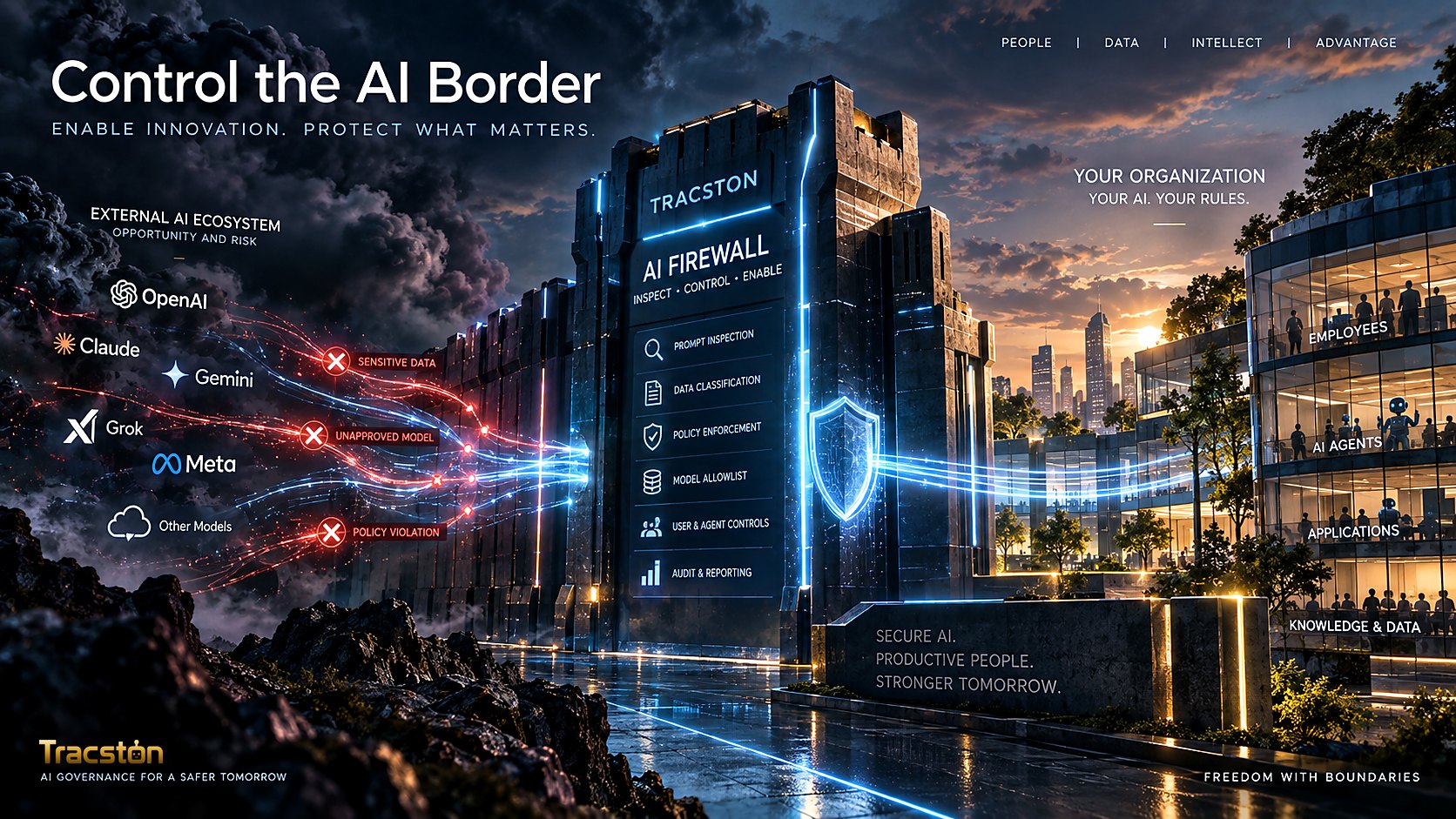
Walk into most office buildings and the first thing you meet is a reception desk. The people there do not stop everyone from coming in; that would defeat the purpose of having an office. Instead they ask a few simple questions. Who are you? Who are you here to see? Which floor are you going to? Visitors get a badge that opens some doors and not others. Deliveries go to the loading bay. Nobody finds this oppressive. It is simply how a building lets many people move around safely.
Now imagine a building where the reception desk can only see that someone walked through the front door, but has no idea who they are, what they are carrying or where they are going. That is roughly the position many organizations are in with AI today.
A new boundary
Organizations spent decades building security boundaries around networks, devices, identities and applications. Each boundary answers a different question: which computers can talk to each other, which laptops can connect, who a person is, and which programs they can use.
AI introduces another boundary.
The prompt boundary.
Employees now routinely send organizational information to external AI systems. Usually for good reasons. A developer pastes source code, the instructions that make up the company’s software, to ask why it is not working. An analyst uploads internal documents to get a quick summary. A support agent pastes customer information into a chat to draft a reply. An engineer shares infrastructure details, such as server names and network layouts, while troubleshooting. A manager asks for help polishing a paper on business strategies. And now and then, somebody pastes a block of text that contains credentials, such as a password or an access key, without noticing they were there.
None of these people is trying to cause harm. Most are trying to do their job faster. But every one of these prompts carries information across a boundary that the organization may not be watching.
Why the traditional firewall cannot see it
The traditional firewall does not understand the meaning of this traffic. From the network’s perspective, the user simply made an HTTPS request, the same kind of encrypted web connection used to load any website. A prompt containing a customer list and a prompt asking for a cake recipe look almost identical from the outside.
That is why AI environments increasingly require a new type of control layer: an enterprise AI firewall. It sits between the people and systems inside the organization and the AI models outside it, and it reads each request well enough to understand what is being asked, by whom, and where it is going.
Its purpose is not merely to block AI. It is to understand how AI is being used. Blocking is the easy part. Understanding is what makes it possible to say yes safely.
The questions it asks
Like the reception desk, an AI firewall works by asking a short list of questions about every interaction:
- Which employee initiated the interaction?
- Which application or agent generated it?
- What information is being sent?
- Which model will receive it?
- Is the destination approved?
- Does the request contain restricted information?
- Should the request be allowed, modified, redirected, logged or rejected?
The second question matters more every month. Many prompts are no longer typed by people at all. They are generated by applications and by AI agents, programs that carry out tasks on their own. An agent that sends thousands of requests a day needs the same scrutiny as a person, and probably more.
The last question is where the real value lies. A firewall that can only say yes or no forces a crude choice. One that has five options can respond in proportion to the risk:
- Allow
- The request is fine. Let it through.
- Modify
- Remove or mask the sensitive part, such as a password or an account number, and send the rest.
- Redirect
- Send the request to a different, approved model, for example one the organization runs itself.
- Log
- Let it through but keep a record, so the organization can learn and review later.
- Reject
- Stop the request and explain why, ideally with a suggestion for what to do instead.
A familiar pattern in security
The concept is similar to earlier security transitions. Each new kind of technology eventually needed a guard that understood its language.
| Layer | What it understands | The question it answers |
|---|---|---|
| Network firewall | Connections | Can this computer talk to that one? |
| Application firewall | Web requests | Is this request to our website safe? |
| AI firewall | Intent and context | Should this information go to this model, for this purpose? |
Network firewalls understood connections. Application firewalls understood web requests.
AI firewalls must understand intent, context and organizational policy.
Intent is what the person or agent is trying to do. Context is who they are, what they are working on and what the information is. Organizational policy is the set of rules the company has decided on. Only when all three are understood together can a decision be both safe and sensible.
What this means for your organization
Find out what is already happening. Before writing rules, learn which AI tools people use, how often and for what. Most organizations are surprised by the answer.
Decide what must never leave. Agree on a short list of information that should never reach an external model, such as passwords, customer identity numbers or unreleased financial results. Start small and specific.
Offer an approved route. If people have a safe, approved AI tool that works well, far fewer will reach for an unapproved one. A firewall works best when “redirect” is an option.
Treat agents like people. Include applications and AI agents in your plans, not just employees typing into chat windows.
Explain, do not just refuse. When a request is stopped or changed, tell the person why and what they can do instead. People follow rules they understand.
Tracston works on these questions in Imperium.