Imperium — AI Governance & Control
AI Governance Should Not Mean Blocking AI
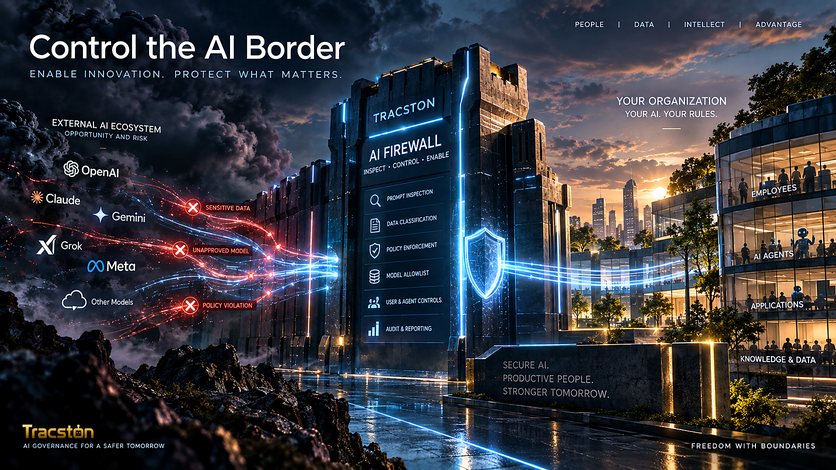
Banning AI pushes people to use it in secret and allowing everything invites trouble, so the better path is to watch first and add controls only where the risk is real.

When a town builds a new road, it does not put traffic lights on every corner on the first day. Nor does it leave the road without rules. Usually, the town watches first. Where do cars bunch up? Where do people cross? Where do accidents nearly happen? Then it adds a sign here, a crossing there, and a traffic light only at the junction that truly needs one. The result is a road that is both safe and useful.
Most organizations are now building their first roads for AI. Many are unsure whether to put lights on every corner or none at all.
Two extremes, neither of which works
Many organizations approach AI governance from one of two extremes. Allow everything. Or block everything. Neither approach scales.
Blocking public AI tools may reduce certain risks, but it also encourages shadow usage and prevents organizations from benefiting from AI productivity. Shadow usage is what happens when people use tools their employer has not approved, on personal phones, home computers or private accounts. It does not stop the risk. It simply moves it somewhere the organization can no longer see. Meanwhile, the organization gives up real gains in speed and quality that its competitors may be enjoying.
Allowing unrestricted access creates the opposite problem: data leakage, uncontrolled costs, inconsistent model usage and limited accountability. Confidential information ends up in tools the organization does not control. Bills grow with nobody watching. Different teams use different AI models for the same work and get different answers. And when something goes wrong, nobody can say who did what.
A more practical approach is progressive governance.
Progressive governance, step by step
Progressive governance means introducing control gradually, in proportion to what you learn about real risk. Think of it as several operational modes, applied one after another:
- Observe AI activity first.
- Understand what employees and agents are actually doing.
- Introduce warnings where appropriate.
- Enforce specific policies only where the risk justifies it.
Each mode has a different purpose, and each builds on the one before:
| Mode | What happens | Why it matters |
|---|---|---|
| Observe | AI activity is recorded, nothing is stopped | You learn what is really going on |
| Understand | Patterns are reviewed with the teams involved | You separate real risk from imagined risk |
| Warn | People see a message when they approach a line | Most people change course on their own |
| Enforce | A small number of actions are stopped or rerouted | Firm limits land only where they are needed |
Agents deserve a mention here. Much AI activity is no longer typed by people at all. It is carried out by AI agents, programs that perform tasks on their own. Progressive governance applies to them in the same way: watch what they do before deciding what they may do.
This is similar to how mature security systems are deployed. Before enforcing a new firewall policy, organizations usually monitor traffic. Before blocking an application, they understand its usage. Security teams learned long ago that a rule written without evidence tends to break something important, and that people route around rules they do not understand.
AI governance should work the same way.
Boundaries, not control of every prompt
The objective is not to control every prompt. The objective is to establish organizational boundaries: a small number of clear lines, drawn where the organization genuinely cares, with freedom on either side of them. For example:
- Financial information may be allowed only with specific models. Perhaps ones the organization runs itself or has a contract with that protects its data.
- Source code may stay within approved environments. Developers keep using AI, but through tools that do not send the code to places the company has not vetted.
- Certain departments may have different policies. A legal team handling confidential cases and a marketing team writing public blog posts face very different risks. One rule for both will be too strict for one and too loose for the other.
- Some agents may operate autonomously while others require approval. An agent that sorts incoming emails can run on its own. An agent that can make payments should probably wait for a person to say yes.
Governance becomes powerful when policies follow organizational context rather than forcing every employee and every AI workload into the same rule set. Context means who the person is, what team they are in, what information they are handling and what the AI will do with it. The same request can be fine in one context and risky in another.
What this means for your organization
Start by watching. Before writing any AI policy, spend a few weeks learning which tools are used, by whom and for what. Base your rules on that evidence.
Talk to the heaviest users. The teams that use AI most are usually the ones with the most to lose from a clumsy ban. Ask what they need.
Offer a good approved option. Most shadow usage disappears when there is a safe tool that works well. Governance is easier when “yes, use this instead” is available.
Prefer warnings to walls. A clear message at the right moment changes most behavior. Save hard blocks for the few cases where the risk is serious.
Write rules by context. Instead of one rule for everyone, set a few rules by department, type of information and type of agent.
Tracston works on these questions in Imperium.