
A virtual operations employee for the paperwork nobody wants.
OfficeManager connects to the company mailbox, finds the invoices and receipts already in it, extracts them into a structured registry, keeps the documents in an encrypted vault, chases the payments, tracks the time, bills from it and hands your accountant a package at the end of the period — on the web, on iPhone and iPad, with an AI assistant over the top.
The filing cabinet is already full. It is your inbox.
Small and medium businesses do not lose invoices — they receive every one of them, by email, and then never do anything structured with them. The document is in the mailbox, the amount is in nobody’s system, and at the end of the quarter somebody spends two evenings reconstructing it. OfficeManager starts from the mailbox because that is where the truth already is.
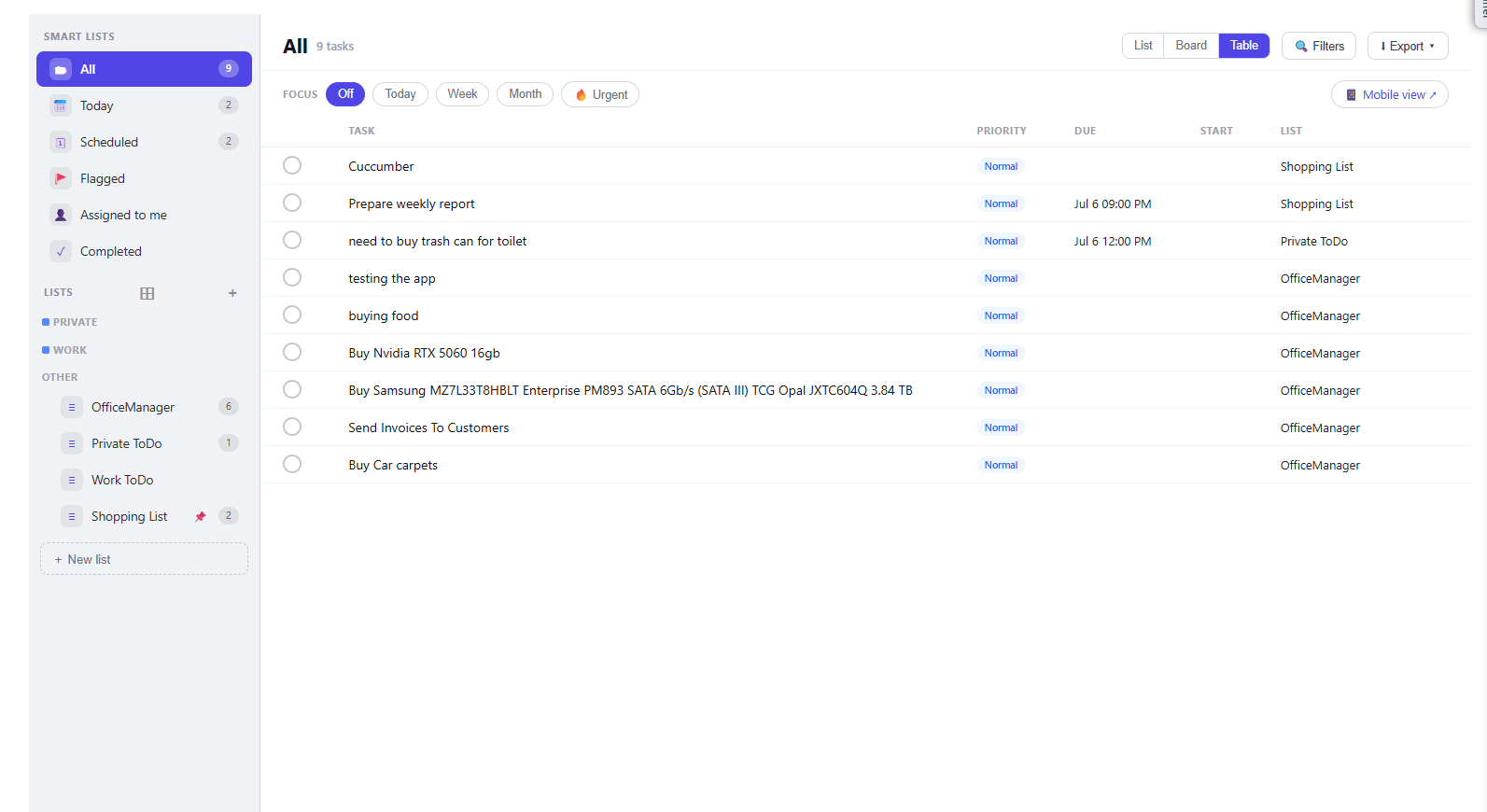
One instance, and it is yours.
Module count is of distinct routes registered by the shipping web client. The core runs as a single application against your own database and your own vault.
Five things that follow from starting at the mailbox.
It goes and gets the paperwork itself
The mailbox is the filing cabinet, and nobody files it. OfficeManager connects to the company mailbox over the Gmail API or IMAP, finds the invoices and receipts already sitting in it, extracts them and registers them — so the work of collecting documents stops being a person’s job.
A structured registry, not a folder of PDFs
Every document that comes in becomes a record with a vendor, a date, an amount, a currency and a status — searchable, filterable and exportable. The PDF is still there; it is just no longer the only place the information lives.
The vault is encrypted, because it is your mail
Documents are held in an encrypted blob vault on the instance you run. The product reads a company mailbox, which is about as sensitive as business data gets, and the honest answer to “where does it go?” is: your database and your vault.
It chases the things people forget
Payment reminders, obligations and recurring sends run on a scheduler inside the application. Nothing depends on somebody remembering that the electricity bill is due, or that the accountant needs last month by the fifth.
It hands the accountant a package, not a shoebox
The output is an export an accountant can actually work from — the registry, the documents and the period, assembled. The product does the collecting and the structuring; it does not pretend to be the accounting package at the other end.
Open core, and the line is a real one.
Community
Open source, AGPL-3.0The core application and its web client are open source under AGPL-3.0. Mailbox collection, the invoice registry, the encrypted vault, search, reminders, time tracking and the accountant export are all in it. Build with OM_EDITION=community and the commercial modules are stripped out entirely.
- Mailbox collection (Gmail API / IMAP)
- Invoice registry & encrypted vault
- Search, filters & reporting
- Reminders & scheduler
- Time tracking, timesheet & billing
- Accountant exports
Enterprise
Commercial extensionsThe commercial modules add the AI layer and the multi-party surfaces — extraction and the assistant, an accountant portal, multiple companies under one instance, chat-channel integration and compliance packs.
- AI extraction & assistant
- Accountant portal
- Multi-company
- WhatsApp & Slack integration
- Compliance packs