
The AI Agent Workforce Has a Workspace Problem
People at work have email, calendars, shared files and task lists, but AI agents usually have none of these, and that becomes a real problem as their number grows.
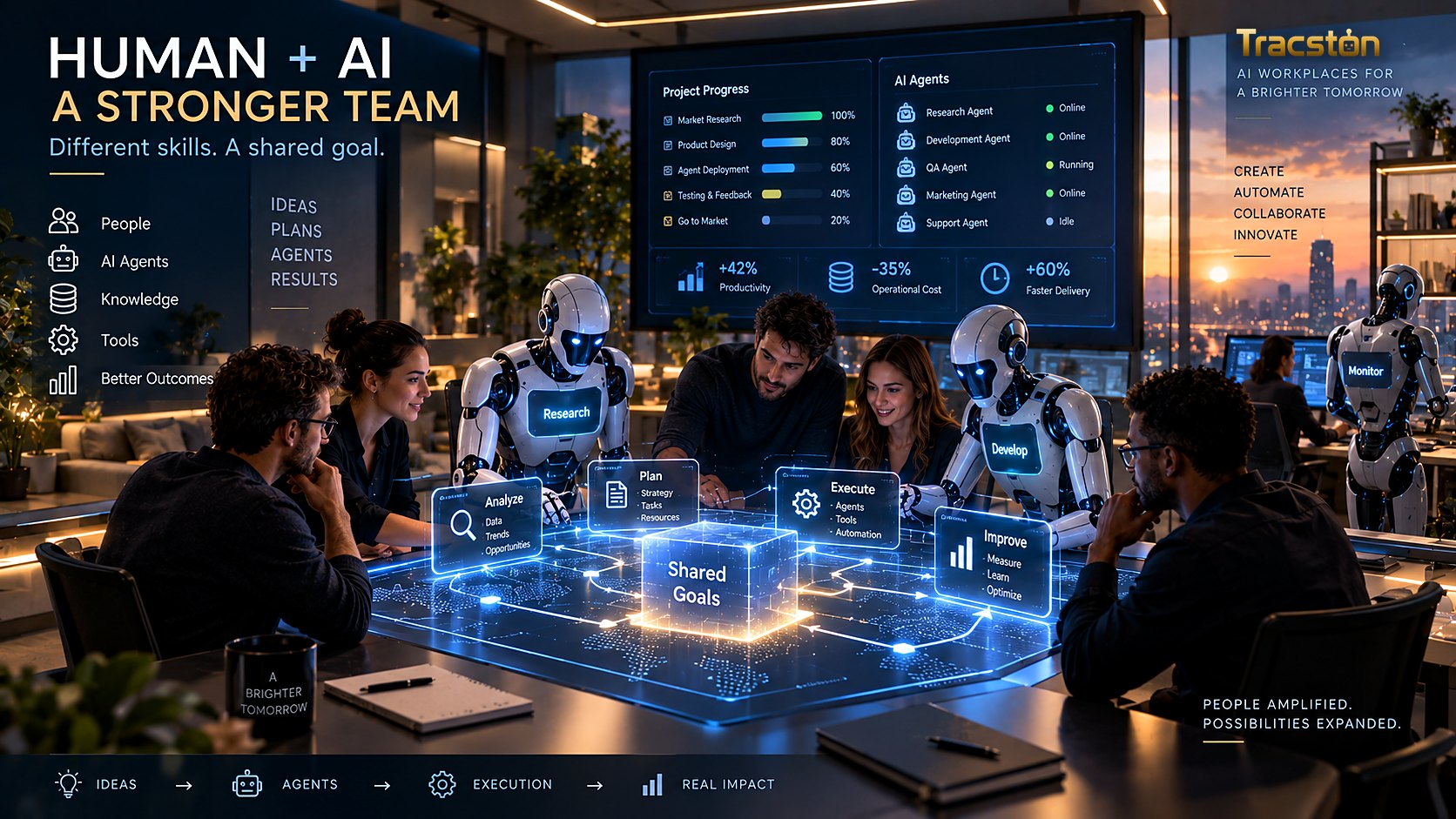
Imagine starting a new job and finding no desk, no email account, no login and no idea who your manager is. Instead, someone hands you a sticky note with a task, a second sticky note with a password, and tells you to leave your finished work on a chair in the corridor. You might get the job done once or twice. But nobody would call it a sensible way to run a team, and it would fall apart the moment there were a hundred of you.
This is, roughly, how many AI agents work today.
The workplace people take for granted
Human employees have an entire digital workplace. They have email and chat to communicate, calendars to coordinate, and documents to create and share. They have task systems that say what needs doing and who is doing it, and dashboards that show how things are going. They have credentials, the logins and passwords that open the right systems, and project tools that keep related work together. Developers have development environments set up with everything they need to write and test code.
We rarely think about any of this. It is just “work”. But every piece of it solves a real problem: how to hand work over, how to share what you know, how to prove who you are, how to show progress and how to ask for help.
AI agents often have none of this structure.
How agents work today
Instead, they operate inside isolated frameworks, scripts or individual applications. A framework is a toolkit developers use to build agents. A script is a small program written for one job. Either way, each agent tends to live in its own separate box.
One agent receives a task. Another agent processes a document. Another executes code. Another communicates with an API, the connection through which one piece of software talks to another. Each may have been built by a different team, at a different time, with different tools.
Each may have different context, credentials and memory. Context is the background information an agent needs to do its job. Memory is what it keeps from one task to the next. When every agent holds its own copy of these, they drift apart. One agent knows about yesterday’s change, another does not. One has a password stored safely, another has one written into its code.
As the number of agents grows, this fragmentation becomes difficult to manage. With three agents, a developer can keep track in their head. With three hundred, nobody can.
What a workspace for agents would provide
The emerging AI workforce needs something that resembles a workspace. A place where agents can do the ordinary things that make shared work possible. Each item below mirrors something people already have:
- Receive tasks
- A clear place where work is assigned, instead of instructions scattered across scripts. The equivalent of a task list.
- Share context
- Common access to the information a job needs, so every agent works from the same facts. The equivalent of shared folders.
- Access approved tools
- A known set of systems each agent is allowed to use, and no others. The equivalent of the software on a work laptop.
- Use credentials securely
- Passwords and keys held safely and issued when needed, never written into code. The equivalent of a company login.
- Coordinate with other agents
- A way to hand work over and avoid doing the same thing twice. The equivalent of chat and meetings.
- Store work products
- A place where results are kept, found and reused. The equivalent of a document library.
- Report progress
- A visible status for each piece of work. The equivalent of a project dashboard.
- Request human approval
- A clear, reliable way to pause and ask a person before an important step. The equivalent of asking your manager.
- Maintain continuity
- The ability to keep working on a long job across hours or days, and pick up where it left off. The equivalent of your notes from yesterday.
None of these are new ideas. They are the everyday infrastructure of any organized team. What is new is applying them to workers made of software.
Not people, but not scripts either
This does not mean pretending AI agents are human employees. Agents do not need lunch breaks, career paths or motivation. Giving them names and faces does not make them easier to manage.
It means recognizing that autonomous systems require operational infrastructure. Operational infrastructure is the plumbing that lets work run reliably day after day: assigning, tracking, securing, recording. Scripts running on their own do not have it. Teams of agents need it.
The challenge is no longer simply “How do we create an agent?” That problem is becoming easier every month. The more important question is:
How do we operate hundreds or thousands of agents together?
Operating means the day-to-day work of keeping something running well: knowing what is happening, fixing what goes wrong, adjusting what is inefficient and being able to explain what happened afterwards.
What this means for your organization
Count your agents and where they live. List the agents your teams use and note where each one keeps its tasks, information, passwords and results. The number of different places is a good measure of fragmentation.
Find the shared work. Look for processes where several agents contribute to one result. These gain most from a common place to work.
Take passwords out of scripts. If any agent keeps its credentials inside its own code, move them to a proper secure store. It is the quickest risk to reduce.
Make progress visible. For your most important agent-driven process, make sure someone can see at a glance which step each piece of work has reached.
Decide where people come in. Agree which steps need human approval, and make sure the agents have a clear way to ask for it.
Tracston works on these questions in Otopia.