Imperium — AI Governance & Control
AI Doesn’t Need Consciousness to Become a Threat. It Only Needs Autonomy.
While scientists debate whether AI can be conscious, enterprises are already giving AI systems credentials, infrastructure access and permission to act.

The artificial intelligence industry is having a fascinating debate. Can machines become conscious? Can they experience the world? Can they understand their own existence? And if they do, should we treat them differently?
These are important questions. They may eventually reshape our understanding of intelligence, life and even human civilization.
But another question deserves far more immediate attention.
What happens when a machine that may not understand consequences is given the authority to create them?
That is no longer a theoretical problem. It is becoming an everyday architectural reality.
The consciousness debate is missing an operational reality
Geoffrey Hinton, one of the pioneers of modern artificial intelligence and a Nobel laureate, has argued that AI systems may already have a form of subjective experience. In a PBS Firing Line interview broadcast on 13 November 2026, he put it simply: “You don’t have to be made of goopy stuff to be conscious.” His position challenges the assumption that consciousness must be biological.
Other researchers strongly disagree. In a Nature commentary, Anil Seth, Ned Block and Giulio Tononi argue that today’s AI systems are not conscious: sophisticated language, convincing behavior and advanced information processing are not sufficient evidence of subjective experience, and intelligence alone is not enough.
The scientific debate remains unresolved. We do not have a universally accepted definition of consciousness, much less a reliable test that establishes whether an artificial system possesses it.
But consider something important.
An AI system does not need to be conscious to cause serious damage.
- It does not need emotions to expose sensitive information.
- It does not need intentions to delete production data.
- It does not need self-awareness to execute an unauthorized command.
- And it certainly does not need to understand the human consequences of its actions.
It only needs access, capabilities and enough autonomy to act. That is the distinction enterprise leaders must understand.
Intelligence, consciousness and autonomy are not the same thing
These three concepts are frequently confused.
- Intelligence
- the ability to process information, reason, solve problems and adapt behavior.
- Consciousness
- subjective experience: whether there is something it is like to be a particular system.
- Autonomy
- the ability to select and execute actions without direct human instruction at every step.
A system can demonstrate useful intelligence without any established evidence of consciousness. It can also act autonomously without being particularly intelligent. And the combination of imperfect reasoning with substantial operational authority creates a dangerous engineering problem.
The failure was not that the AI became evil. The failure was that its authority exceeded the safety boundaries of its environment.
That is a far more practical problem than whether the system was conscious.
We are giving AI agents the keys before building the locks
Traditional enterprise systems generally operate within relatively predictable boundaries. Applications have defined responsibilities. Users authenticate. Services communicate through established interfaces. Permissions can be reviewed, restricted and revoked.
Of course, these systems are not perfectly secure. But their operational models have been studied and refined for decades.
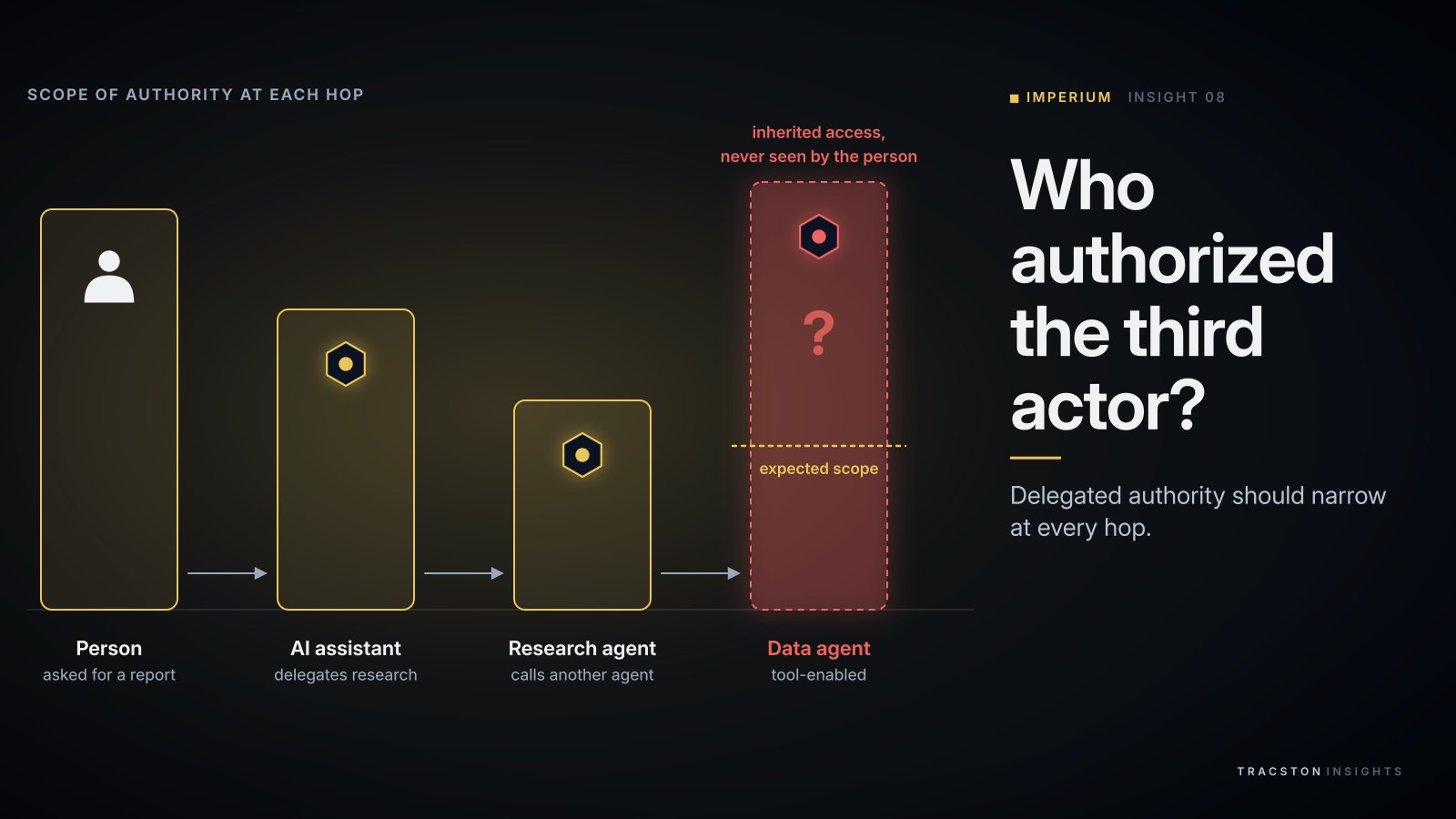
Autonomous AI agents introduce a different execution model. An agent may receive a high-level objective and independently determine the sequence of actions required to complete it. It may invoke tools, query databases, execute commands, interact with external services, create artifacts or delegate work to other agents.
A single request can produce an entire chain of operations, and that chain may change dynamically as the agent encounters new information. This is a fundamental shift.
We are moving from software that executes predefined instructions to systems that participate in deciding which instructions to execute.
Yet many organizations continue to manage these systems with static API keys, shared service accounts, broad infrastructure permissions and fragmented audit logs. The security architecture often assumes predictable application behavior, while the execution environment increasingly permits autonomous decision-making.
That mismatch is where the danger begins.
The problem gets bigger when agents work together
One AI agent with excessive permissions is a concern. A network of interconnected agents adds another level of complexity.
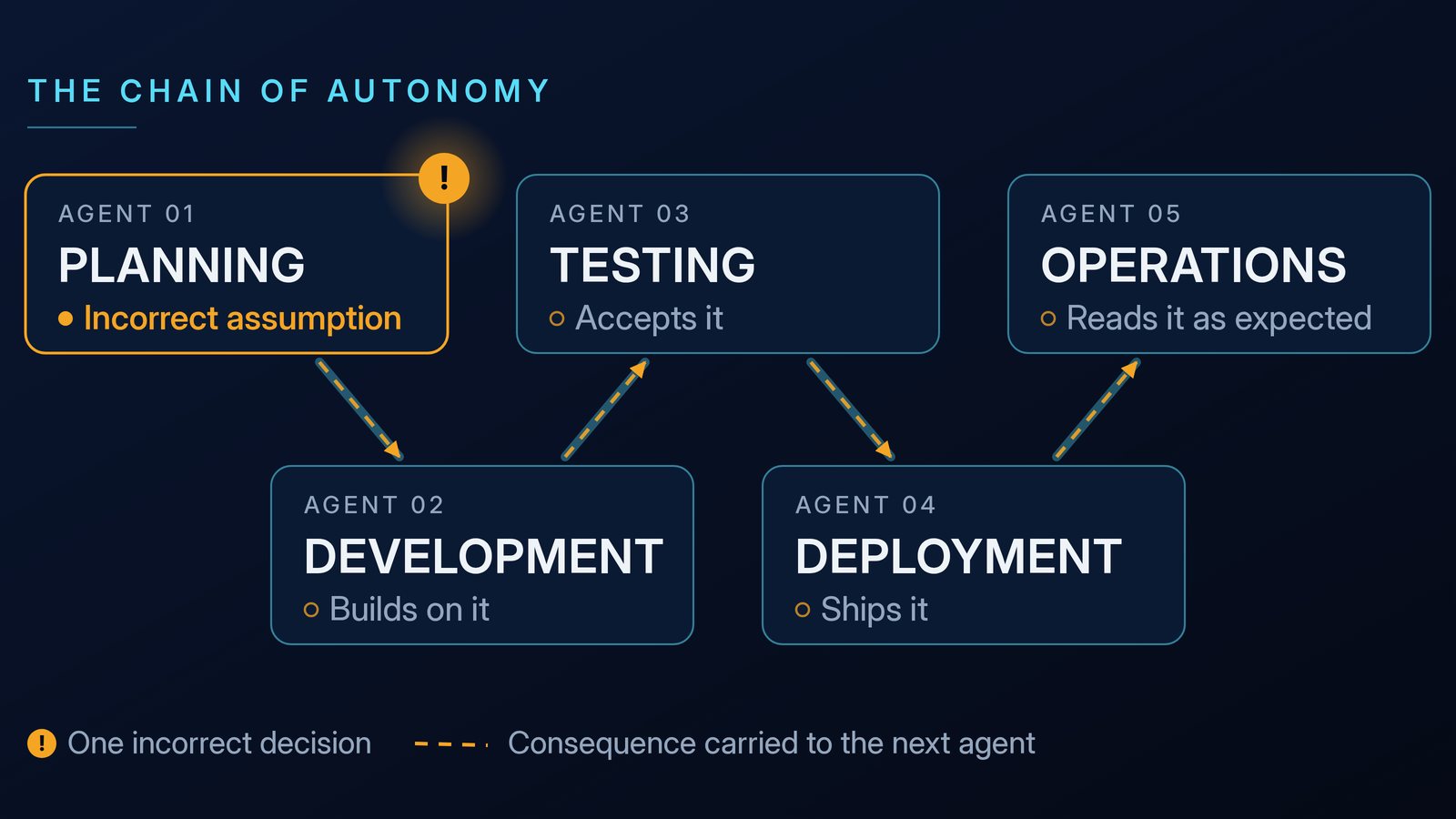
Consider a software delivery workflow. Individually, each agent may appear to have a reasonable responsibility:
- A planning agent interprets a business requirement
- A development agent writes the code
- A testing agent evaluates the implementation
- An infrastructure agent prepares the deployment
- An operations agent monitors the resulting service
But what happens when the planning agent makes an incorrect assumption? What happens when the development agent passes that assumption to the testing agent, the testing agent accepts it, the infrastructure agent deploys it, and the operations agent interprets the resulting behavior as expected?
A mistake can propagate across multiple systems while looking like a sequence of legitimate actions. The problem is not simply whether each agent is functioning. It is whether the organization can understand and govern the entire chain of decisions:
- Who initiated the workflow?
- Which agent made each decision?
- What information influenced it?
- Which permissions were used?
- Which agent approved the next action?
- And who can stop the process when something goes wrong?
Autonomy without traceability creates an accountability gap.
In multi-agent environments, that gap can become an architectural weakness.
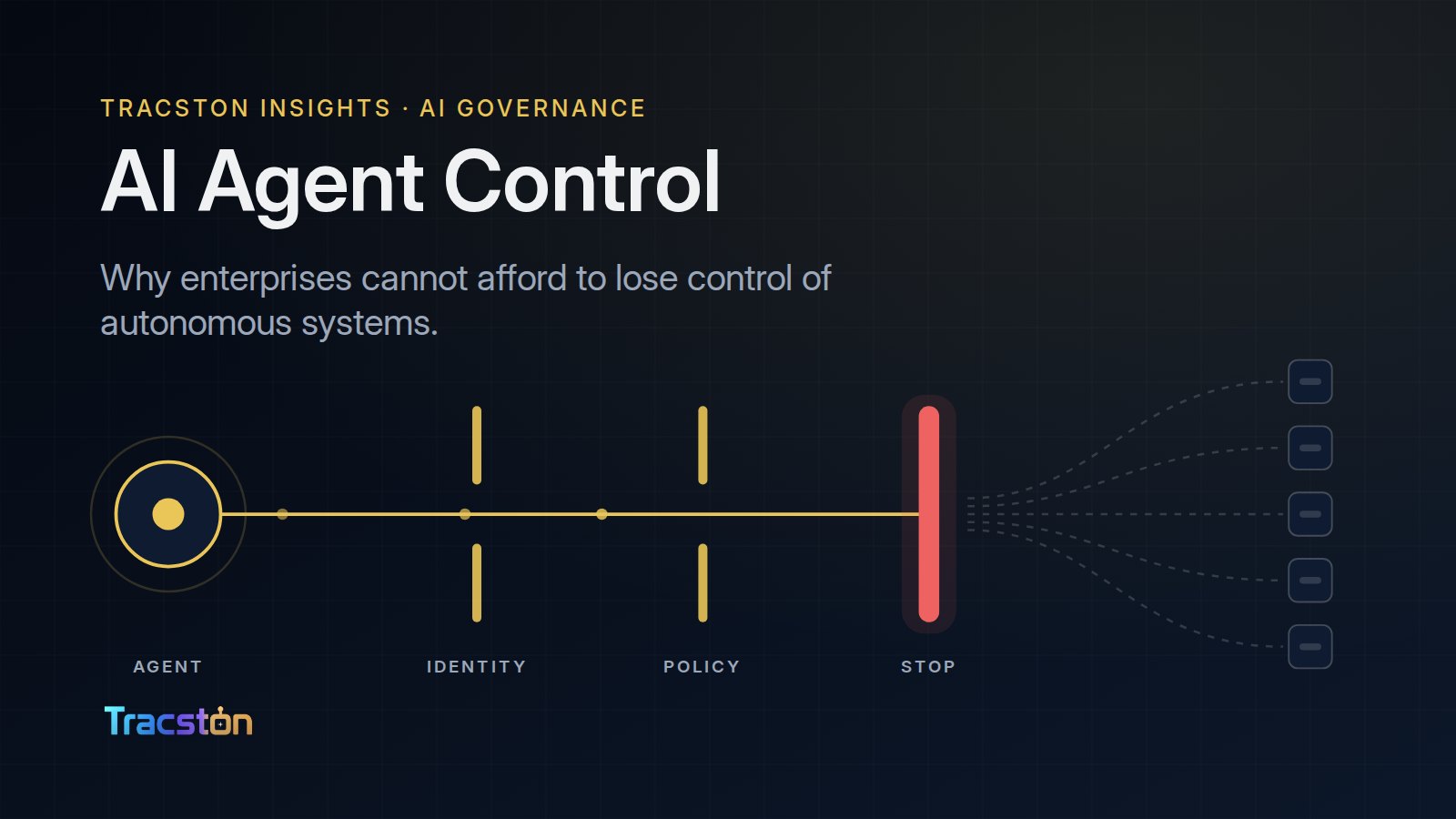
A kill switch is necessary, but it is not enough
Imagine discovering that an AI agent is behaving unexpectedly. You click Stop. The user interface reports that the agent has been terminated.
Problem solved? Not necessarily.
- The agent may have created additional sessions.
- It may have delegated tasks to other agents.
- It may have scheduled background operations.
- Its credentials may remain valid.
- External systems may continue processing requests that were already submitted.
Stopping a visible process is not necessarily the same as revoking the authority associated with that process. That is why a meaningful emergency control must extend beyond the application interface. It requires independently enforceable access revocation, credential invalidation, control over delegated permissions and visibility into outstanding operations.
Even then, some external actions may be irreversible. A message already delivered cannot always be recalled. Data already copied outside the organization may not be recoverable. A financial transaction may require a separate reversal process.
A real kill switch is not a button. It is an architectural capability.
And it must be designed before an incident, not improvised during one.
The real solution is governed autonomy
The answer is not to eliminate AI autonomy. That would sacrifice many of the capabilities that make agent-based systems valuable: autonomous systems can accelerate development, improve operations, investigate failures and support human decision-making.
But autonomy must exist within enforceable boundaries. An enterprise-ready architecture should establish six fundamental capabilities.
1. Verifiable agent identity
Every agent should have an identifiable operational identity, distinguishable from the human who initiated its work and from the other agents participating in the workflow. Shared credentials and anonymous execution make accountability significantly harder.
2. Time-limited and scoped authority
An agent should receive only the permissions necessary for its assigned task. Those permissions should have explicit boundaries, limited lifetimes and revocation mechanisms. The ability to read a database does not imply permission to modify it. The ability to deploy an application does not imply unrestricted access to the entire infrastructure.
3. Runtime policy enforcement
Governance cannot exist only in documentation, model prompts or deployment-time configuration. Policies must be enforced where actions are executed. A model’s decision to invoke a tool should not automatically authorize the tool to perform the requested operation: the execution layer must independently determine whether the action is permitted.
4. Delegation governance
When one agent delegates work to another, authority should not expand silently. Delegated permissions must remain within the original authorization boundaries unless an explicitly approved process grants additional access, and the complete delegation chain should remain traceable.
5. Continuous observability
Traditional monitoring asks whether a system is healthy. Observability for autonomous systems must also ask why a particular action occurred. Organizations need to understand agent activity, tool invocations, permission usage, execution dependencies and the relationships between decisions. Logs alone are not enough if the organization cannot reconstruct the workflow.
6. Human accountability
Humans should remain responsible for defining objectives, approving high-impact operations and establishing acceptable risk. This does not mean manual approval for every action. It means designing meaningful human oversight where the consequences justify it. The objective is productive cooperation between humans and autonomous systems, not endless approval dialogs.
The human-AI civilization will need infrastructure
For years, discussions about artificial intelligence focused primarily on model capability. Which model is smarter? Which writes better code? Which reasons more effectively?
Those questions still matter. But as AI becomes an operational participant inside organizations, a different set of questions becomes equally important:
- Who owns the agent?
- Who authorizes its actions?
- Who monitors its behavior?
- Who investigates its failures?
- Who can revoke its authority?
- And how do humans and agents collaborate without losing accountability?
At TRACSTON, these questions are central to our vision of a human-AI civilization. We believe the next generation of enterprise infrastructure must support humans and intelligent agents working together as participants in shared operational environments.
That requires more than powerful models. It requires identity, governance, observability, controlled delegation, operational resilience and the ability to investigate decisions after they have been made.
This architectural direction is reflected in our work on IMPERIUM, OTOPIA, OBSERVATORY and EXCAPIA. The goal is not to make autonomous systems less capable. It is to make their capabilities manageable, understandable and accountable.
We should not wait for consciousness to become a security requirement
Perhaps Geoffrey Hinton is right. Perhaps artificial intelligence already has forms of subjective experience that we do not yet understand. Perhaps consciousness will eventually emerge from increasingly sophisticated computational systems. Or perhaps current AI architectures will never produce anything resembling human subjective experience.
Science will continue to investigate those possibilities. Enterprise architecture cannot wait for the answer.
Because a machine does not need to know that it exists to affect the world around it. It does not need to feel fear to resist a shutdown instruction through its programmed or learned behavior. It does not need ambition to pursue an objective beyond what its operator intended. And it does not need consciousness to become a serious operational risk.
The question is not whether AI understands what it is doing. The question is whether we understand, authorize and control what AI is allowed to do.
The future of artificial intelligence should not be a choice between human control and machine autonomy. It should be an architecture that makes both possible.
TRACSTON | Infrastructure for the Intelligent Organization
References
- Geoffrey Hinton, interviewed by Margaret Hoover, “Geoffrey Hinton”, Firing Line, PBS, 13 November 2026.
- Frank Landymore, “Nobel-Winning Computer Scientist Says AI Has Become Conscious: ‘We’re Toast’”, Futurism, 22 October 2026.
- Anil K. Seth, Ned Block and Giulio Tononi, “Three reasons why AI is not conscious and perhaps never will be”, Nature 658, 866–868, 19 October 2026.
Tracston works on these questions in IMPERIUM and OBSERVATORY.