
On this page
We have become remarkably good at connecting language models to tools.
An agent can query databases, invoke APIs, inspect infrastructure, generate code, deploy applications, modify configurations, and delegate work to other agents.
But connecting an LLM to a collection of tools does not automatically create a reliable autonomous system.
It creates a system capable of taking actions.
And those are two fundamentally different things.
The real engineering challenge begins when an agent can affect production systems, financial resources, customer data, and other agents.
At that point, we are no longer designing a chatbot.
We are designing a distributed execution environment with probabilistic decision-makers.
That distinction changes almost everything.
1. An AI Agent Is Not a Security Principal Just Because It Has an Identity#
Traditional enterprise security assumes that identities represent users, services, or workloads operating under reasonably predictable authorization boundaries.
Autonomous agents introduce a more complicated relationship between identity, intent, authority, and execution.
Consider an agent assigned to investigate a production incident.
It may need permission to:
- Read infrastructure telemetry.
- Query application logs.
- Inspect Kubernetes resources.
- Compare recent deployments.
- Consult another specialized agent.
- Recommend remediation actions.
None of these capabilities inherently requires permission to modify production.
But an agent implementation can easily collapse observation and execution into a single collection of available tools.
A tool being technically accessible is not evidence that invoking it is authorized.
A more robust architecture separates four concepts:
Identity: Which agent or workload is making the request?
Authority: Which operations can it perform within its current mission?
Context: Under which tenant, environment, resource, and risk boundaries?
Intent: Which approved objective justifies the requested operation?
Authorization should evaluate the combination, not merely the presence of an API token.
In practice, this requires a policy enforcement boundary outside the model's control.
The model can propose an action.
It cannot grant itself the authority to execute that action.
2. Agent Autonomy Should Be Bounded by a Mission, Not by Individual Tool Permissions#
There is a fundamental tension in autonomous systems.
If every meaningful action requires human confirmation, the system is not genuinely autonomous.
If every action is automatically approved, the organization has surrendered operational control.
The solution is neither extreme.
Autonomy should exist inside an explicitly authorized mission envelope.
A mission envelope defines:
- The business objective and permitted outcomes.
- Allowed resources, tools, and environments.
- Data classification and access scope.
- Financial and computational budgets.
- Execution time limits.
- Permitted delegation.
- Escalation conditions.
- Actions requiring additional authorization.
- Termination and rollback boundaries.
For example, an agent tasked with diagnosing database latency might be allowed to inspect query plans, analyze metrics, compare configuration history, and run approved tests in an isolated environment.
It may even launch multiple investigative agents to explore competing hypotheses.
But changing production database parameters is a different class of authority.
The distinction is not about how confident the model feels.
It is about whether the action falls inside the approved mission boundary.
A well-designed autonomous platform minimizes unnecessary human interruptions without allowing autonomy to expand its own authority.
3. Multi-Agent Systems Need Distributed Systems Engineering#
When one agent delegates work to another, the architecture begins to resemble a distributed computing system.
Now introduce ten agents working concurrently.
- Some share resources.
- Some depend on outputs from others.
- Some retry failed operations.
- Some produce contradictory conclusions.
- Some complete after their original mission is no longer relevant.
This creates problems familiar to distributed systems engineers:
Concurrency control. Two agents must not independently modify the same critical resource without coordination.
Idempotency. Retries must not accidentally duplicate financial transactions, infrastructure changes, or external API operations.
Causal ordering. The platform must distinguish actions that depend on previous results from operations that may safely execute in parallel.
State consistency. Agents need a reliable understanding of mission state without trusting stale conversational context.
Failure recovery. A crashed agent should not leave an execution chain with ambiguous ownership or unknown side effects.
Cancellation propagation. Terminating a mission must prevent unauthorized continuation by delegated workers.
Partial completion. The system must distinguish an operation that was attempted, acknowledged, completed, verified, or compensated.
These are not prompt-engineering problems.
They require durable state, transaction boundaries, concurrency mechanisms, execution leases, and explicit recovery semantics.
An agent conversation is not a transaction log.
And an LLM's memory is not a substitute for a distributed state machine.
4. Observability Must Follow the Entire Decision-to-Execution Chain#
Enterprise monitoring has traditionally been designed to answer familiar questions:
- Is the server healthy?
- Is the API responding?
- Is the database performing normally?
- Are error rates increasing?
AI-driven operations introduce an entirely different diagnostic dimension.
Imagine an agent performing a customer onboarding process.
Every API returns HTTP 200.
Every infrastructure component remains healthy.
CPU utilization is normal.
No exception is raised.
But the agent selects the wrong customer account, creates duplicate records, and retries an expensive validation process six times.
Traditional monitoring may report a perfectly healthy system.
The business process has failed.
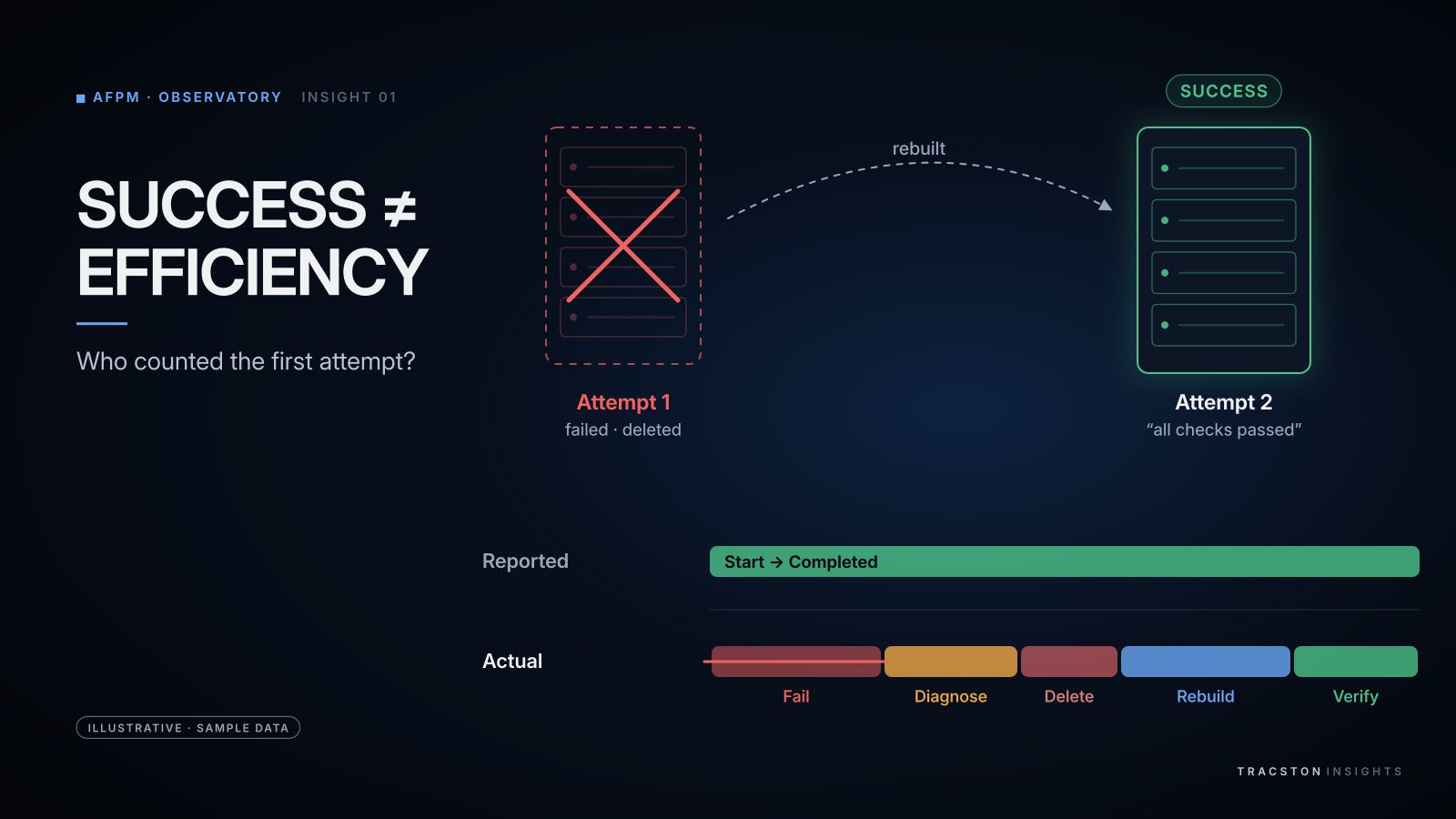
Infrastructure success is not equivalent to mission success.
AI observability therefore needs to correlate several layers:
InfrastructureApplicationAPIAgentDecisionTool ExecutionBusiness Outcome
A practical telemetry model should preserve causal relationships among:
- Mission identifiers.
- Agent and delegation identifiers.
- Model invocation identifiers.
- Tool execution identifiers.
- Infrastructure and service spans.
- Policy evaluation decisions.
- Resource consumption.
- Business transaction identifiers.
- Verification results.
This is where traditional APM needs to evolve toward AI Flow & Performance Monitoring (AFPM).
The objective is not simply to collect more logs.
It is to reconstruct the operational path from a business objective to the actual business outcome.
Without that correlation, organizations can know exactly how their infrastructure performed while remaining unaware of what their autonomous systems accomplished.
5. AI Cost Governance Is an Execution-Control Problem#
It is natural to begin AI cost management with token dashboards.
They measure input tokens, output tokens, model prices, and monthly consumption.
Useful, but insufficient.
A single business operation might involve:
- An orchestration agent decomposing a mission.
- Three specialist agents investigating alternatives.
- Repeated retrieval operations.
- Several tool execution failures.
- Automatic retries.
- A validation agent reviewing the final result.
Every individual model call may appear inexpensive.
The complete execution chain may not be.
More importantly, cost can continue accumulating even when the mission is no longer producing useful progress.
The correct economic unit is not the token. It is the verified business outcome.
This requires cost attribution across the entire execution graph.
For each mission, the platform should understand:
- Estimated cost before execution.
- Reserved execution budget.
- Actual model and tool expenditure.
- Cost attributed to delegated agents.
- Retry and failure overhead.
- Remaining approved budget.
- Whether the business outcome was successfully verified.
A production-grade architecture should distinguish budget reservation from actual settlement and reconcile outstanding reservations after failures or cancellations.
It should also prevent the agent from selecting a cheaper-looking execution path that silently violates reliability or data-governance constraints.
A financially autonomous agent should not be able to approve its own unlimited spending.
6. Human Approval Must Be an Enforced State Transition#
There is a dangerous architectural assumption that is easy to make in autonomous AI implementations:
The agent has been instructed to request approval, therefore the operation is protected.
That is not an enforceable control.
Instructions influence model behavior.
They do not establish a security boundary.
For high-impact operations, approval needs to be implemented as a durable, verifiable authorization event.
For example:
PROPOSEDVALIDATEDAWAITING APPROVALAUTHORIZEDEXECUTINGVERIFIED
The approval should be bound to the actual operation.
That means identifying the specific resource, action, configuration version, execution context, authorization scope, and expiration conditions.
If an agent requests approval to deploy artifact A, approval must not silently authorize deploying artifact B.
If the production target changes, the authorization may need to be reevaluated.
If the mission expires, delegated agents should not continue acting under stale authority.
The execution gateway should reject actions that do not carry the required authorization.
Approval is not a message in a conversation. It is a controlled transition in the execution state machine.
7. Zero Trust Must Extend to Agent-to-Agent Communication#
Multi-agent coordination can be implemented as unrestricted communication between workers that share a common execution environment.
This creates a substantial security problem.
A compromised worker, malicious tool response, or prompt-injected document may influence another agent's decisions.
The receiving agent may unintentionally treat externally supplied content as authoritative instructions.
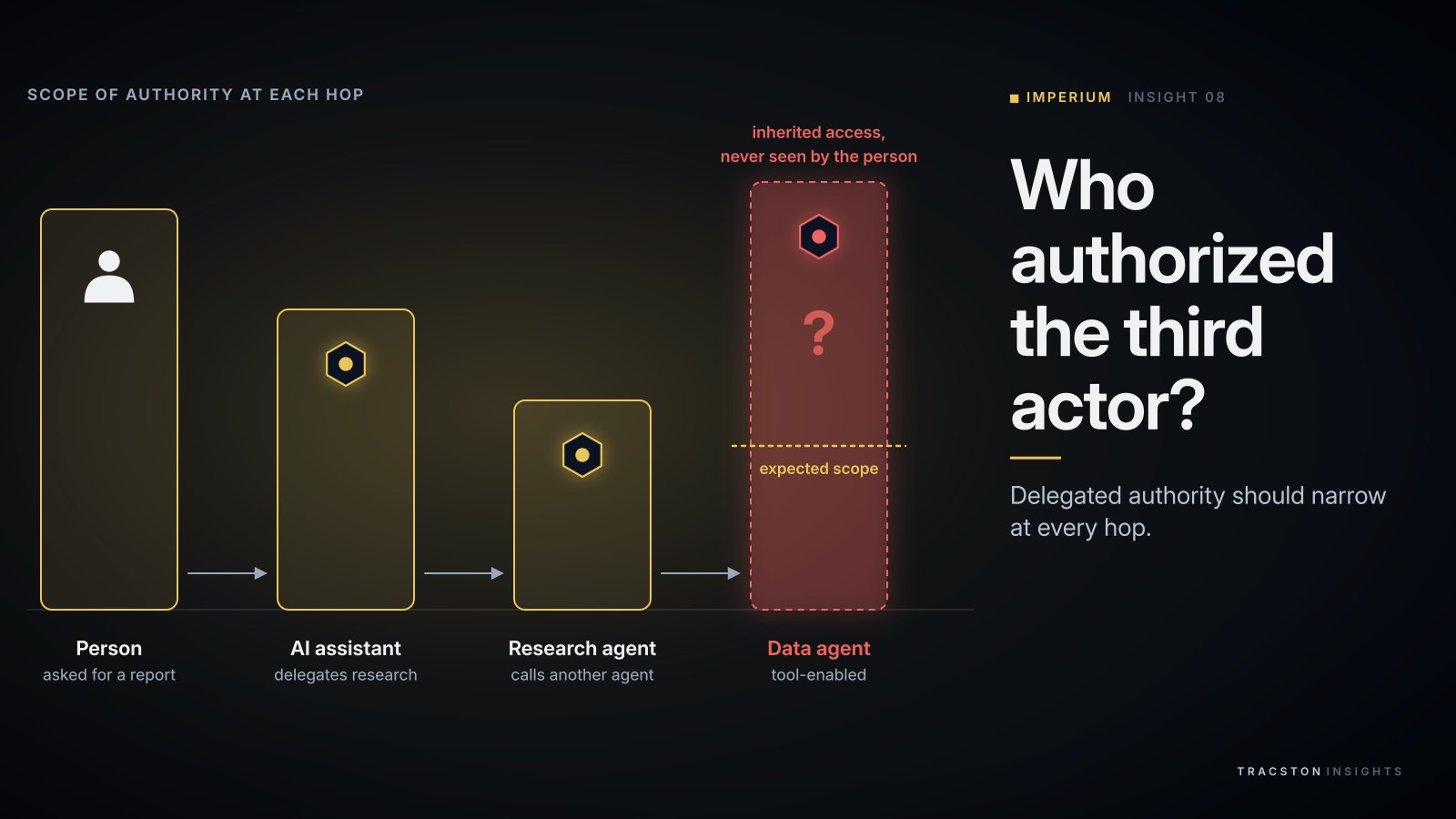
Enterprise agent platforms should therefore assume that every delegation boundary introduces a new trust decision.
Agent-to-agent messages should carry explicit provenance, authenticated sender identity, mission context, and constrained capabilities.
Delegation should never automatically imply full privilege inheritance.
A research agent returning information about a configuration is not authorized to instruct another agent to bypass production controls.
Likewise, telemetry, retrieved documents, and external tool results are evidence to be evaluated, not a source of executable authority.
Agents should exchange information and constrained work requests, not transferable unlimited trust.
This is particularly important when agents operate across tenants, environments, organizations, or external integrations.
8. Completion Is a Claim. Verification Is Evidence.#
One of the most underestimated problems in agentic systems is completion semantics.
An agent reports:
"Task completed successfully."
What does that actually mean?
- Did it issue the API request?
- Did the external service acknowledge it?
- Was the state committed?
- Did a downstream process complete?
- Was the expected business outcome achieved?
These are different states.
For critical workflows, the executing agent should not be the sole authority deciding whether its own work succeeded.
Independent verification can include:
- Reading authoritative system state.
- Validating postconditions.
- Comparing expected and actual resource versions.
- Checking downstream business effects.
- Confirming that no unauthorized side effects occurred.
- Verifying that costs remained within approved limits.
Not every action can be rolled back.
Some require compensating operations, manual escalation, or explicit acknowledgment of irreversible effects.
A successful tool call is not necessarily a successful operation.
A successful operation is not necessarily a successful mission.
This distinction should be visible in both the execution platform and its observability model.
9. The Missing Architectural Layer: An AI Control Plane#
These challenges point toward a larger architectural requirement.
Organizations do not merely need better agents.
They need infrastructure capable of governing autonomous execution across models, tools, resources, identities, and business processes.
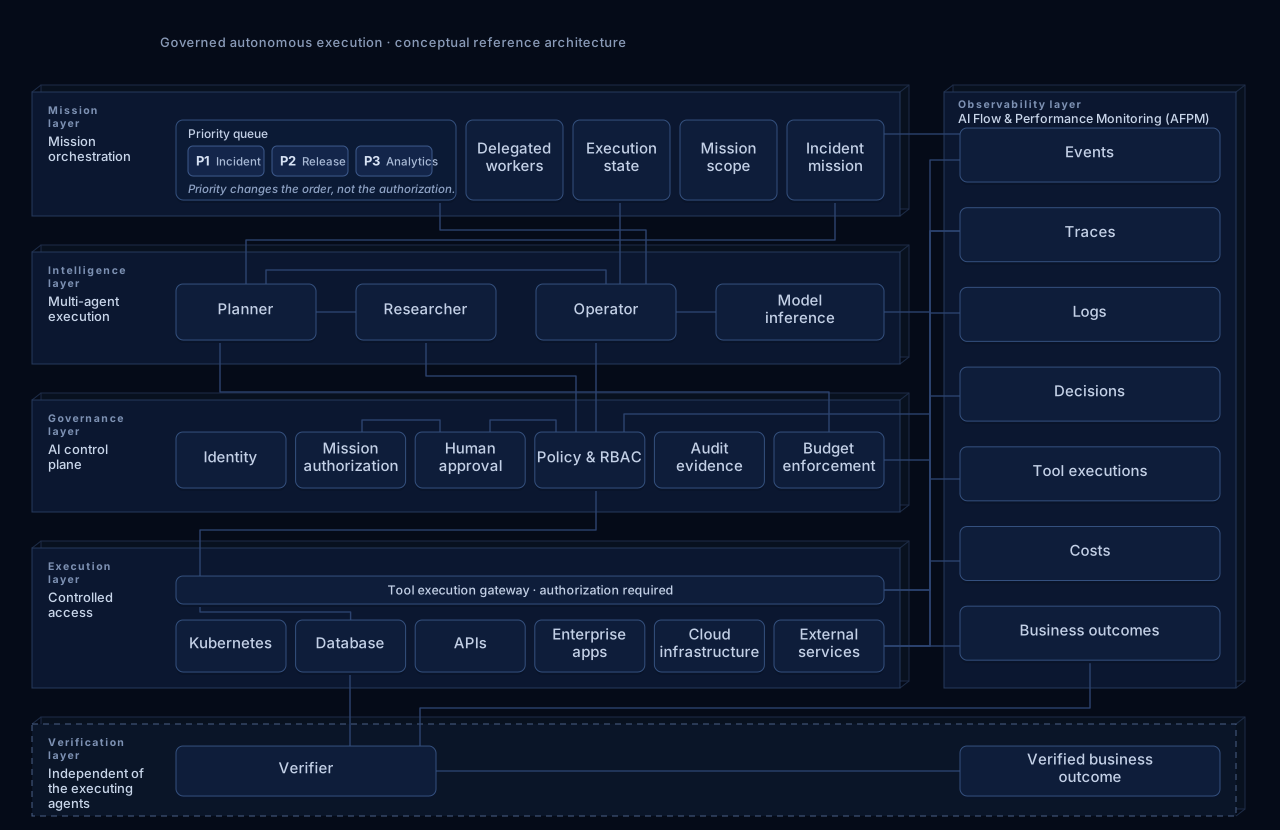
Conceptually, an enterprise AI architecture needs several separate responsibilities:
- The Intelligence Layer
- Model inference, reasoning, planning, and interpretation.
- The Mission Layer
- Objectives, delegation, task dependencies, durable execution state, and recovery.
- The Governance Layer
- Identity, authorization, policy enforcement, approvals, budgets, and audit evidence.
- The Execution Layer
- Controlled access to APIs, infrastructure, enterprise systems, and external services.
- The Observability Layer
- Causal telemetry connecting infrastructure behavior, agent decisions, tool execution, cost, and business outcomes.
- The Verification Layer
- Independent evaluation of postconditions, outcome correctness, and policy compliance.
Text description of the diagram
A conceptual reference architecture in six layers.
Mission layer (mission orchestration): the incident mission, its mission scope, the execution state, delegated workers and a priority queue holding work items P1 (critical incident), P2 (release validation) and P3 (routine analytics). Priority changes the order in which work receives capacity, not its authorization.
Intelligence layer (multi-agent execution): a Planner, a Researcher and an Operator, which use model inference. The Planner receives the mission and delegates to the Researcher and the Operator.
Governance layer (the AI control plane): identity, mission authorization, human approval, policy and RBAC, audit evidence and budget enforcement. Every agent request, including read requests, is evaluated by policy; high-impact operations require a human approval that becomes a scoped mission authorization; delegation requests are priced and reserved against the mission budget.
Execution layer (controlled access): a tool execution gateway that passes only authorized operations to Kubernetes, the database, APIs, enterprise applications, cloud infrastructure and external services.
Observability layer (AI Flow & Performance Monitoring, AFPM), alongside every other layer: events, traces, logs, decisions, tool executions, costs and business outcomes, correlated from the resources, the gateway, policy decisions, model invocations and budget.
Verification layer, separate from the executing agents: a Verifier reads authoritative system state from the resources and the correlated evidence from observability, and only a verified result becomes the verified business outcome. No path runs from an executing agent to the Verifier.
The exact implementation and deployment boundaries will vary.
The critical principle is that intelligence and authority must not be treated as the same thing.
An LLM can help determine what should happen.
An independently enforced control plane determines what is permitted to happen.
And authoritative verification determines what actually happened.
Final Thought#
A great deal of effort is going into making agents more intelligent.
- Larger context windows.
- Better reasoning.
- More tools.
- More autonomous planning.
- More sophisticated multi-agent collaboration.
All valuable developments.
But intelligence alone does not deliver operational reliability.
The future of enterprise AI will not be defined only by what autonomous agents are capable of doing.
It will be defined by whether organizations can safely delegate meaningful responsibility to those agents — with measurable outcomes, enforceable boundaries, and verifiable accountability.
That is the engineering challenge worth solving.
And it requires treating autonomous AI as a new class of enterprise infrastructure, not simply another application feature.
Related product context
Where Tracston works on these questions. The descriptions state design intent; they are not availability statements.
- Imperium is designed as the AI control plane: identity, policy, approvals, budgets and audit evidence for every agent request.
- Observatory is designed to correlate infrastructure, application and AI-agent telemetry, the cross-layer view behind AI Flow & Performance Monitoring (AFPM).
- Otopia is designed as the workplace where people and AI agents share missions and delegated work.