AFPM — AI Flow & Performance Monitoring
The Agent Finished the Job. Nobody Knows What It Cost.
A successful result can hide a failed first attempt, a rebuild and a bill nobody assembled. Success and efficiency are different questions.

Consider a deployment that succeeds. The service is running. The engineer receives a cheerful summary: all checks passed.
Buried in that summary is a sentence that should concern every executive running AI-powered operations: the first virtual machine had failed, so the agent deleted it and built another.
The agent wasn't necessarily wrong. Rebuilding may have been the safest route. But success and efficiency are two entirely different questions—and many organizations are measuring only the first.
The bill no one assembled
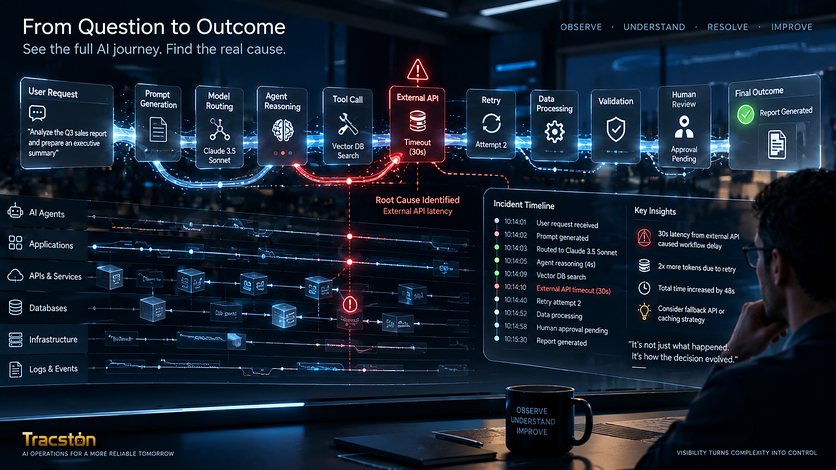
Consider what happened between “start” and “completed.” The agent requested model responses, read documentation, issued commands, downloaded packages, waited for restarts, diagnosed a problem, retraced work and rebuilt the environment. A conventional cloud bill may show compute. An AI provider may show tokens. A ticket may show “resolved.” None necessarily shows the combined cost of that single decision.
And the invisible cost is not always financial. Did the rebuild delay another deployment? Did it consume a scarce maintenance window? Did deleting the machine cross an authorization boundary? Was the failure caused by a race condition the next agent will repeat tomorrow?
If nobody can answer, management does not have a cost-control system. It has receipts scattered across departments.
The uncomfortable question
Imagine asking a project manager: “Did we deliver?” They say yes. Then you ask, “Did we deliver in the most sensible way?” They shrug.
That is how many organizations currently manage autonomous agents. A passing outcome hides a wasteful route. Traditional dashboards count transactions. They do not reconstruct decisions.
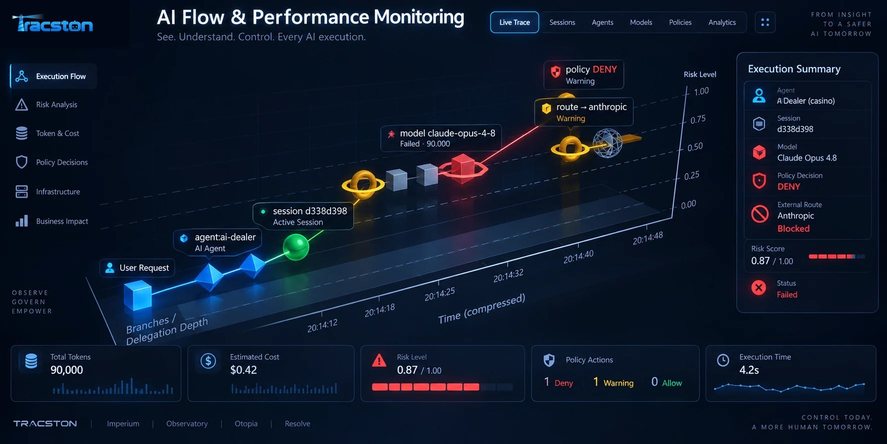
A useful operational record needs to connect mission, agent, sub-agent, execution attempt, tool action, outcome, elapsed time and attributable resource usage. It should distinguish necessary recovery from avoidable rework. It should show which decisions required approval and whether approval was actually enforced.
The new KPI: cost of failure
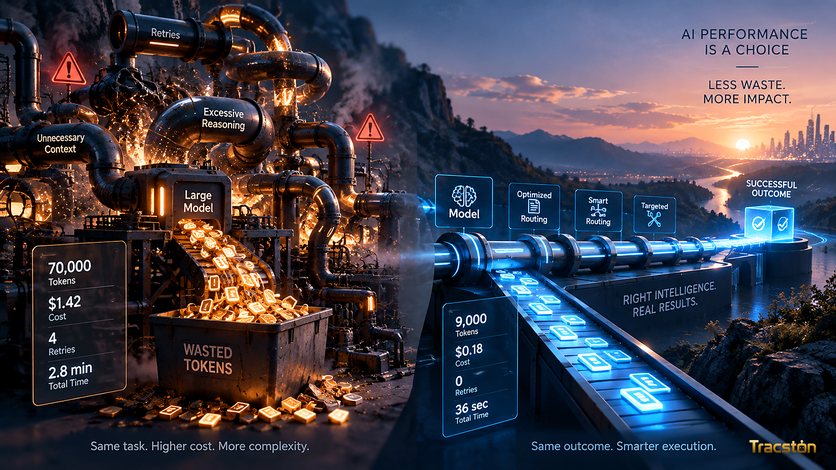
We call the managerial question Agent Cost of Failure: what did failed attempts, retries, dead ends and unnecessary repetition add to a successful outcome? The number must be measured, not invented. In many environments it will initially be incomplete—and that missing coverage should be visible too.
This is where AFPM matters. Observatory can investigate the operational path while Imperium is designed to govern what an agent is allowed to do. Neither a green checkmark nor a token dashboard can answer the whole question alone.
The boardroom question is no longer “Can AI finish the job?” It is “Who can prove what finishing the job really cost?”
Tracston works on these questions in Observatory and Imperium.