AI Flow & Performance Monitoring (AFPM)
From Workflows to MissionFlows
How AI agents are replacing predefined execution paths with adaptive, mission-driven execution.
How AI agents are changing the way software executes work
For decades, software was built around a simple assumption:
The path was known in advance.
A process started. Step one ran, then step two, then step three. If something failed, the process stopped, an alert was raised, and eventually someone investigated.
That model shaped almost everything in IT: cron jobs, ETL pipelines, integration platforms, automation engines, runbooks and monitoring systems.
A file-transfer process, for example, might be defined as:
- Connect to the destination using SFTP
- Copy the file
- Verify that the file arrived
- Send a success notification
If SFTP failed, the workflow failed.
The operator knew what had happened because the path was predetermined.
AI agents change that assumption.
The difference between a Workflow and a MissionFlow
Imagine giving an autonomous agent a different instruction:
“Make sure this file reaches the destination securely before 17:00 and verify that it was processed.”
That is not a workflow. It is a mission.
The agent may initially try SFTP. If SFTP fails, it may discover an API. If the API credentials have expired, it may refresh them. If the primary API is unavailable, it may select another approved endpoint. It may ask another agent for information, inspect documentation, verify a checksum and confirm that the receiving application processed the file correctly.
The mission remains the same. The execution path changes.
That is what we call a MissionFlow.
A MissionFlow is a mission, its boundaries, and the execution path an agent discovers at runtime to accomplish it.
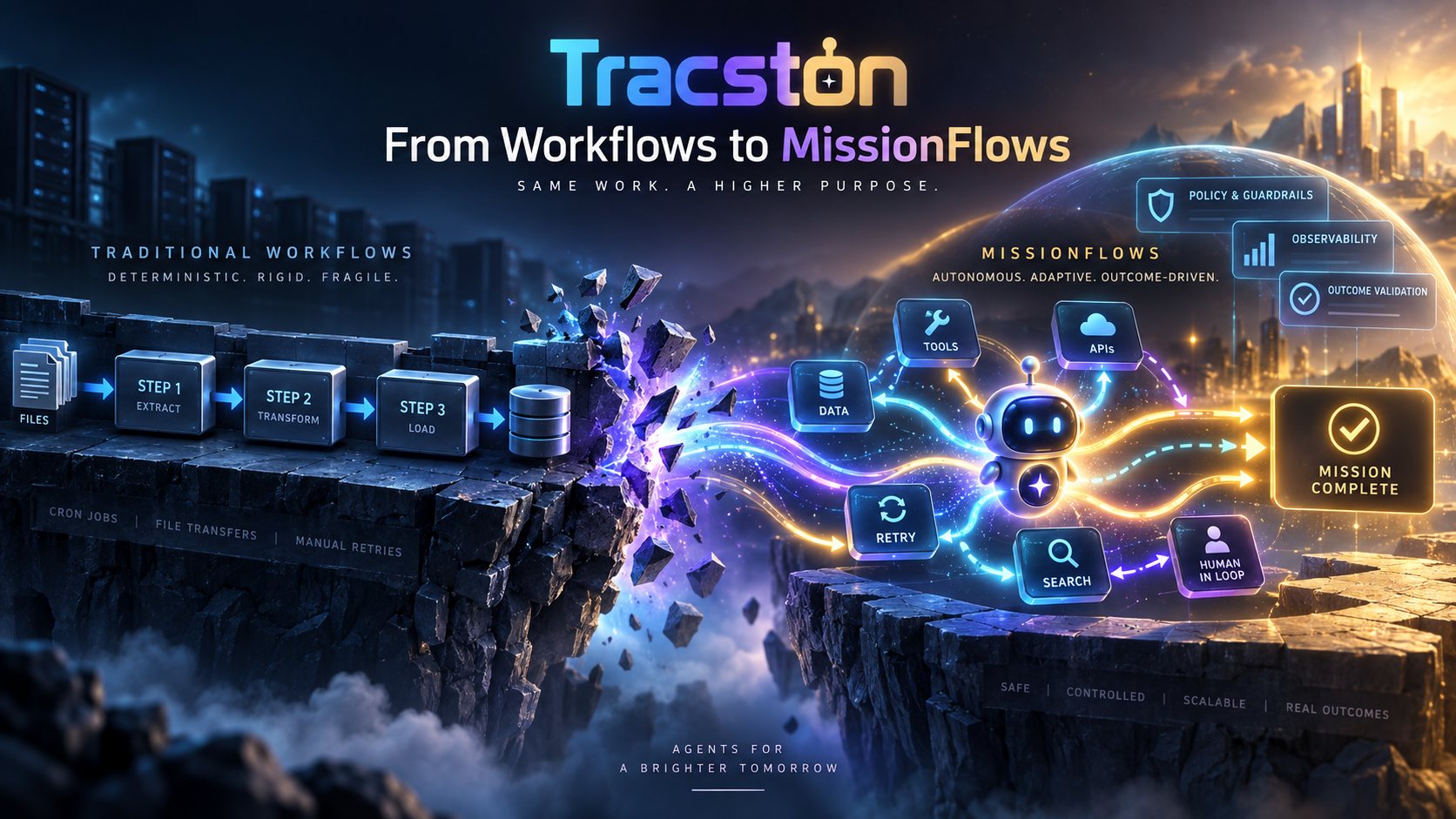
Put simply: a workflow defines the path in advance. A MissionFlow defines what must be achieved and within which limits — and the path is found along the way.
Workflow predefined path
- Step 1
- Step 2
- Step 3
- Step 4
Fixed sequence. If a step fails, the process stops.
MissionFlow mission + guardrails → dynamic execution → outcome
- Mission
- Guardrails
- Plan
- Execute
- Observe
- Adapt
- Validate
- Outcome
The mission and its limits are fixed. The path is found along the way.
The path is not necessarily known when execution begins. It is discovered during execution.
Mission, not goal
The distinction matters.
A goal can be aspirational: reduce costs, improve response times or increase customer satisfaction.
A mission is operational. It must be accomplished. It also carries context and boundaries.
An agent may receive a mission such as:
- Process this invoice and reconcile it with the ERP system.
- Do not expose customer information externally.
- Do not spend more than €0.20 on model usage.
- Require approval before modifying financial records.
- Complete the task within five minutes.
The organization defines what must happen and under which rules.
The agent determines how to get there.
There is a well-known parallel in military doctrine: mission command. Leadership defines the desired outcome, the intent behind it and the operating boundaries — but not the exact steps. The executing unit adapts its actions to what it encounters on the ground.
Agentic computing brings the same idea into software.
Failure no longer means what it used to mean
This creates an immediate problem for traditional monitoring.
Suppose SFTP fails.
In a conventional system, that event may trigger an incident.
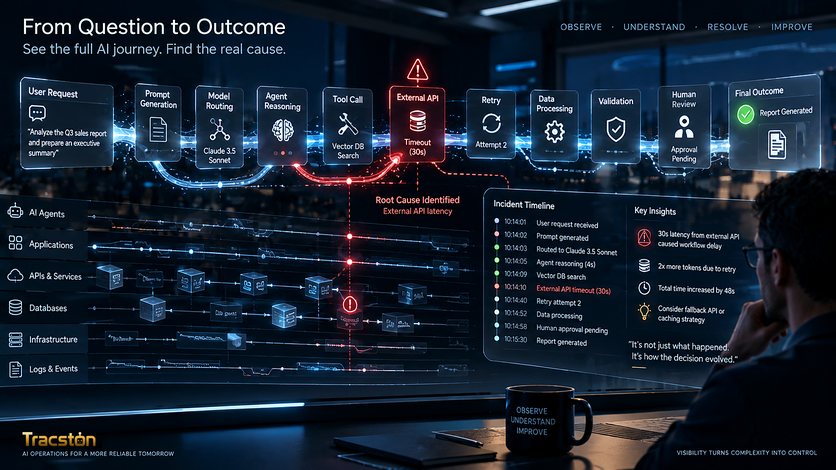
In a MissionFlow, the agent may simply move to an approved API and complete the mission successfully.
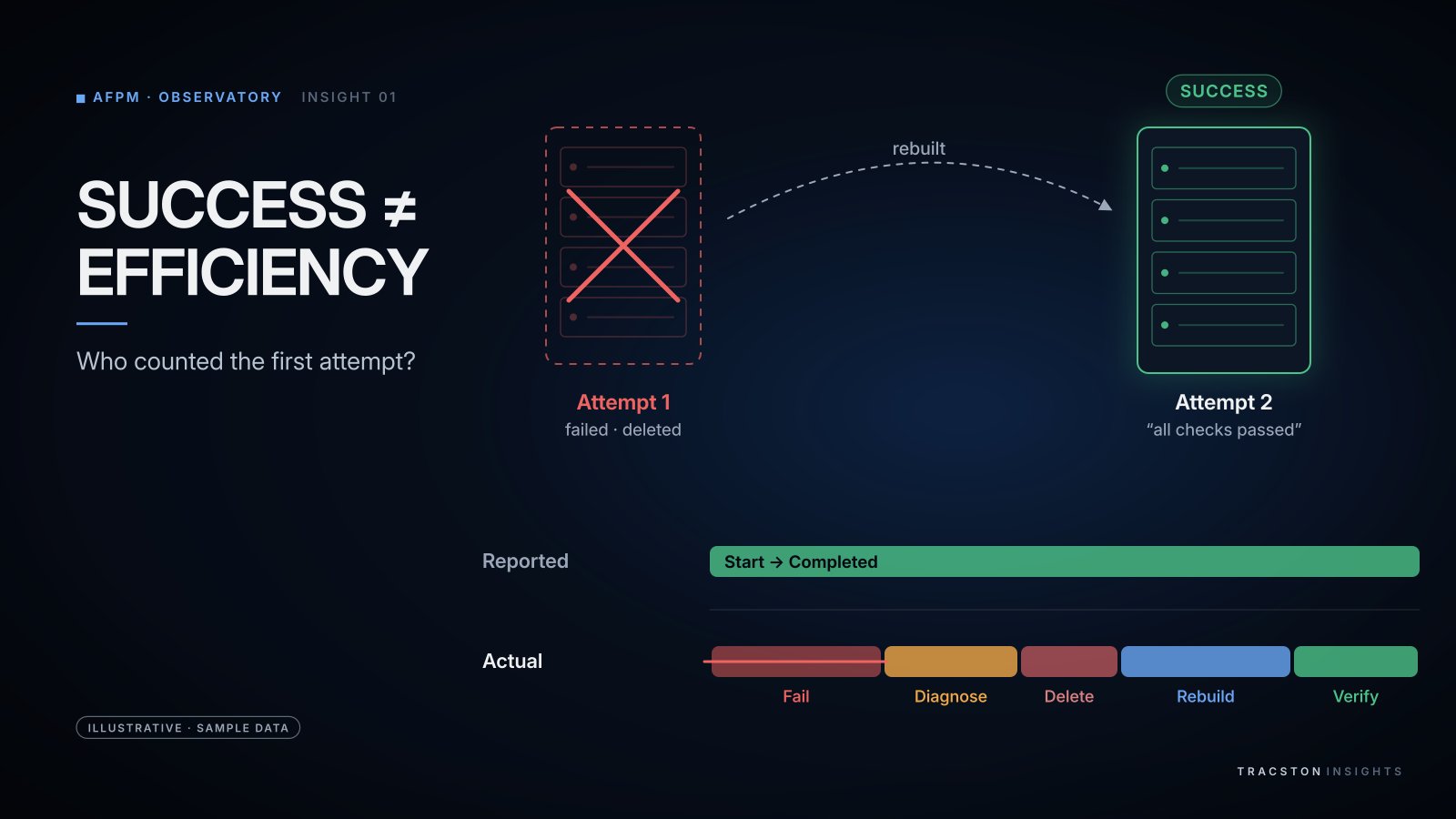
Technically, something failed. Operationally, the mission succeeded.
So what exactly happened?
It may not have been an incident at all. It may have been an adaptation event.
Now imagine that the same adaptation happens 8,000 times every month.
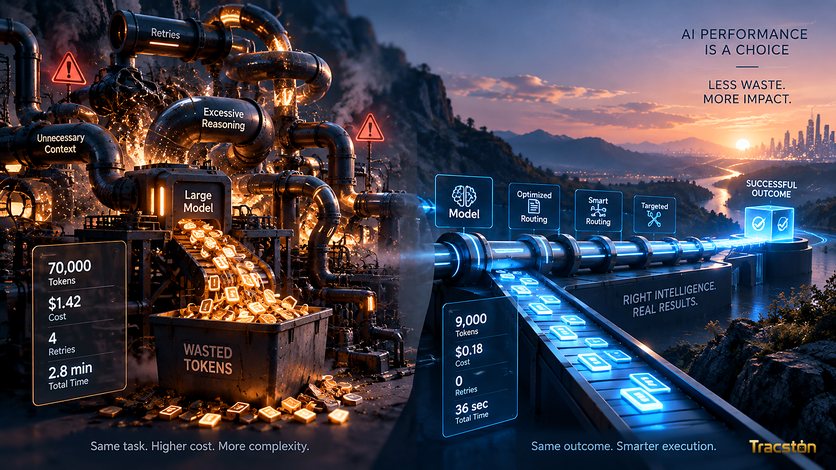
The agent successfully completes every mission, but it repeatedly compensates for a broken integration. Latency increases. Model usage increases. API calls increase. Execution becomes more complex, and risk increases with it.
A traditional monitoring platform might still report one thing. A system designed for MissionFlows should be able to report something very different:
Traditional monitoring
- Service available. No major incidents.
MissionFlow-aware monitoring (AFPM)
- 34% of missions are falling back from SFTP to API.
- Average execution time increased by 17 seconds.
- Estimated additional AI and API cost: €3,820/month.
- Root cause: intermittent authentication failures on the primary path.
The mission succeeds. The execution is unhealthy.
That distinction becomes critical in agentic systems.
The four new types of incidents
Mission-driven execution creates several scenarios that traditional monitoring was never designed to classify properly.
1. Successful mission, poor execution. The task completed correctly. But the agent called six models, used three unnecessary tools and took eight minutes to complete something that normally takes ten seconds.
- Mission: successful
- Execution quality: poor
2. Technical failure, successful mission. The primary API failed. The agent found an alternative approved route and completed the task.
- Infrastructure: degraded
- Mission: successful
3. Successful mission, policy failure. The agent produced the correct result quickly. But it sent sensitive information to an external model that was not approved for that data classification.
- Mission: successful
- Governance: failed
4. Healthy systems, wrong outcome. Every API responded. Every server was online. No exception was generated. But the agent misunderstood the mission and produced the wrong business result.
- Infrastructure: healthy
- Application: healthy
- Mission: failed
These are not edge cases. They represent a new operational model.
Why traditional observability is no longer enough
Infrastructure monitoring remains essential.
We still need CPU, memory, storage, networking, logs, metrics, traces, transactions and service health.
But agentic systems introduce another dimension: decision behavior.
Operations teams now need to understand:
- What mission was the agent executing?
- What constraints applied?
- What plan did it generate?
- Which tools and models did it select?
- Which other agents participated?
- Why did it change direction?
- Which attempts failed?
- What data did it access?
- Which permissions did it use?
- How much did each decision cost?
- How long did each branch take?
- Did it remain within policy?
- Did it achieve the intended business outcome?
- Could it have completed the mission more efficiently?
This is not simply application monitoring with a few extra AI metrics.
It is observability of non-deterministic execution.
AFPM: observing MissionFlows
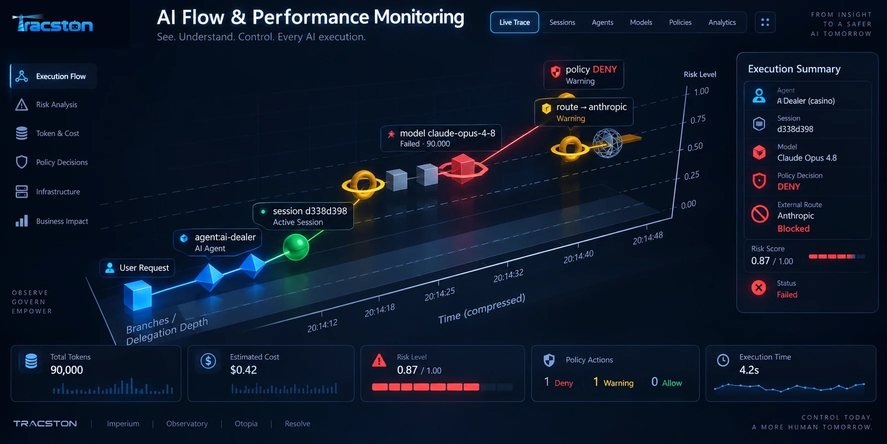
This is where AI Flow & Performance Monitoring (AFPM) comes in.
AFPM is the discipline of observing autonomous, mission-driven execution:
Not simply whether each technical step ran, but whether the mission was achieved, through which path, at what cost, with what decisions, and within which policies.
Traditional APM follows application execution. AFPM follows MissionFlows.
It connects technical telemetry with models, tools, agents, decisions, cost and business outcomes.
- If a MissionFlow changes route five times before succeeding, AFPM should reconstruct that journey.
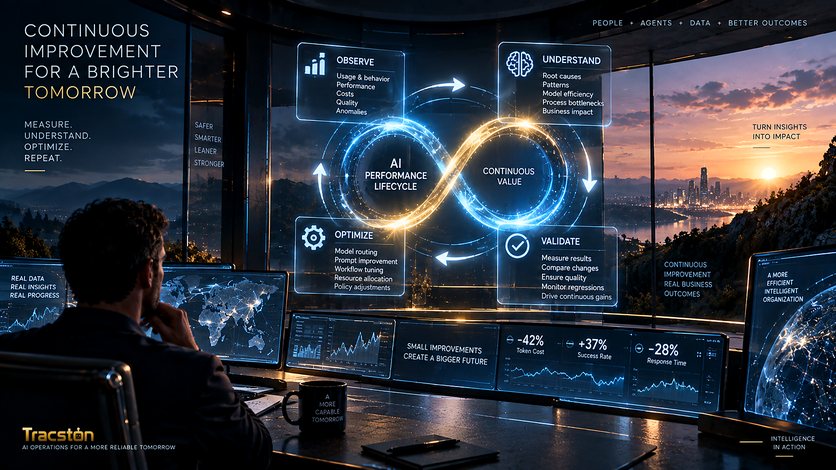
- If two agents complete the same mission through very different paths, AFPM should compare them.
- If one model consistently creates slower or more expensive execution paths, AFPM should identify it.
- If thousands of missions succeed only because agents continuously compensate for a failing service, AFPM should surface the hidden operational debt.
The point is not merely to observe AI.
It is to understand how autonomous work is actually being performed.
Security also becomes mission-aware
Security faces the same transformation.
Traditional security asks questions such as:
- Can this identity access this API?
- Can this service read this database?
- Is this connection allowed?
- Does this account have permission to perform this action?
Those questions remain important.
But autonomous agents create another layer.
An agent can discover tools, combine systems and choose actions that a developer may never have explicitly placed into a predefined workflow.
So organizations increasingly need to ask:
Is this agent allowed to perform this action, for this mission, using this data, under these conditions?
Consider a support agent.
It may be completely legitimate for that agent to retrieve a single customer record to resolve a support case.
The same API credentials might technically allow it to retrieve 50,000 records and build a local dataset because the model decided this would make future work easier.
The credentials are the same. The intent is not.
Agentic security therefore needs more than identity and access management.
It needs mission context, runtime policy, data governance and behavioral enforcement.
Workflows are not disappearing
None of this means workflows become useless. They simply change role.
In deterministic automation, the workflow was the execution itself.
In agentic systems, the workflow becomes a set of guardrails rather than a complete execution plan.
It can define:
- the mission,
- allowed tools,
- prohibited actions,
- approval points,
- budgets,
- time limits,
- data boundaries,
- required validations,
- success criteria.
Inside those boundaries, the agent may adapt.
That is the transition from orchestrating every step to governing autonomous execution.
Many current “AI workflow” platforms still use the old model. They create boxes and arrows:
TriggerConditionLLMActionResult
That is useful automation.
But inserting an LLM into a workflow does not automatically create an agentic system.
A true autonomous agent may decide that an existing step is unnecessary, create a new one, delegate work, select another tool or change its execution plan based on information discovered halfway through the mission.
The workflow is no longer the complete representation of what will happen.
A new operational stack
At Tracston, we see this shift creating three distinct requirements.
Imperium — Governance and Control
Imperium governs what agents are permitted to do.
It controls access to models, tools, data, policies, budgets, approvals and organizational boundaries.
In MissionFlow terms: Imperium governs the boundaries of the mission.
Observatory — Operational Visibility
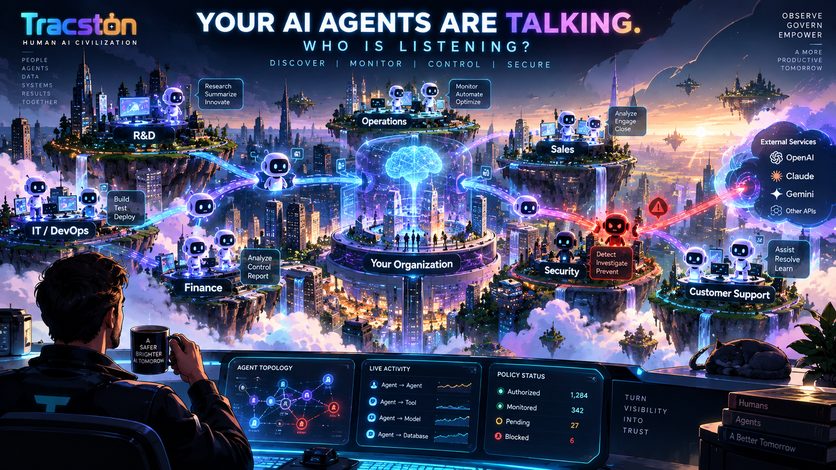
Observatory provides the broader operational picture across infrastructure, applications, networks, services, security and AI systems.
It connects MissionFlows with the systems on which they depend.
An agent’s strange behavior may ultimately originate from a database, network path, Kubernetes service or infrastructure dependency. Observatory provides that wider context.
MissionFlow Intelligence — Tracston’s AFPM layer
MissionFlow Intelligence is the capability inside Tracston’s AFPM layer that focuses on understanding and optimizing autonomous AI execution.
It reconstructs MissionFlows and analyzes their agents, decisions, models, tools, costs, latency, adaptations and outcomes.
In simple terms:
Observatory tells you what is happening across the environment. AFPM tells you how AI-driven missions are actually being executed inside it.
Together with Imperium, the organization can both see and govern autonomous execution.
The metric above all the other metrics
For decades, operations teams have measured system health through familiar technical metrics: availability, latency, error rate, throughput and utilization.
Those metrics remain essential.
But autonomous systems introduce another question above them all:
Did the mission succeed?
And right after it:
- At what cost?
- At what risk?
- Through which path?
- And could it have been done better?
That changes observability from monitoring systems to understanding outcomes.
From deterministic software to mission-driven computing
AI is not simply adding intelligence to existing software. It is beginning to change the execution model itself.
| Traditional | Mission-driven |
|---|---|
| Traditional software follows instructions. | Autonomous software pursues missions. |
| Traditional workflows define the route. | MissionFlows discover the route. |
| Traditional monitoring watches whether predefined steps execute. | AFPM observes how autonomous systems decide, adapt and achieve outcomes. |
| Traditional security protects access to resources. | Agentic governance controls what autonomous systems are allowed to do while pursuing a mission. |
This is still an early transition. But the direction is becoming clear.
The workflow is no longer the process.
The mission is the process. The MissionFlow is how it actually unfolds.
Tracston works on these questions in Observatory and Imperium.